A crack records a separation in material; it does not by itself tell you when the separation occurred or whether it is still changing. Understanding its route, the surrounding construction and comparable observations over time helps turn that finding into an explanation.
Learn to distinguish crack width, distortion and measured change in existing British low-rise buildings. The guide connects those observations to a proportionate investigation and repair decision.
Recognise the route, then investigate
Start with a description another person could locate and check. These three examples provide a vocabulary for the visible route; they do not identify the cause, depth, age or rate of change.
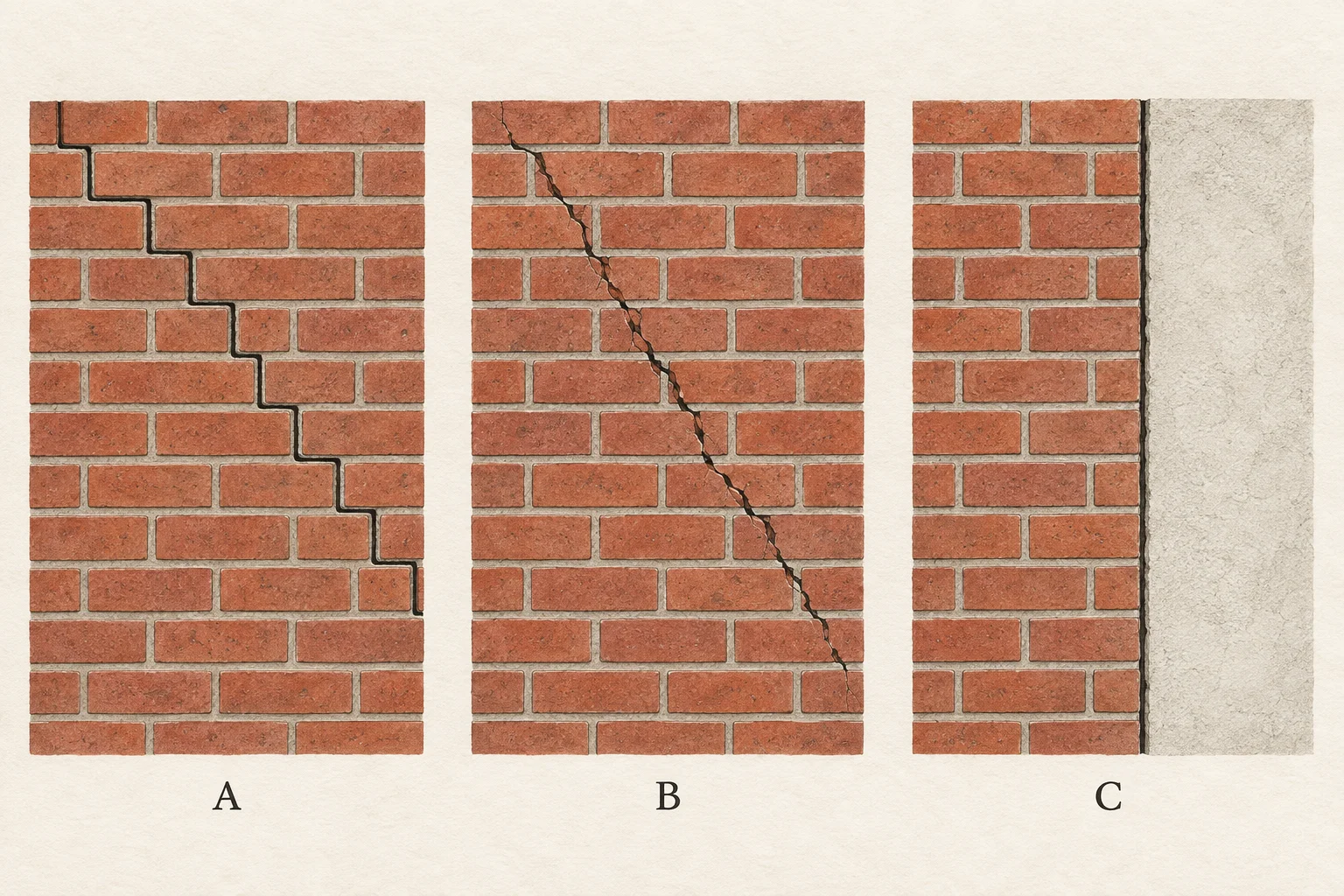
Illustration notes
AI-generated illustration.
A / Along joints
A stepped route
Describe which bed and vertical joints the opening follows. Locate its ends, branches and any change in direction. Record whether units are also visibly fractured; do not assume all damage follows the mortar.
B / Across units
A route through the masonry
Identify the units and joints crossed by the visible crack. Look for accessible corresponding features on adjoining faces. The surface route does not establish continuity through the full wall thickness.
C / At a junction
A separation at an interface
Locate the meeting of materials or building phases. Establish the intended joint and connection from accessible evidence. A straight line alone cannot tell you whether a designed joint, finish detail or damaged connection explains it.
Use these descriptions alongside the building context below. Cracks can combine routes or occur in finishes, stone, concrete and other systems beyond these examples. For damage assessment, BRE stresses the need for wider context and change over time.
Continue with Inspecting and recording movement for the overview, route and point photographs that make a record reusable.
Three questions behind a crack
| Question | What you are trying to understand | A useful comparison |
|---|---|---|
| Where is the separation? | Whether the visible route follows a finish, joint, unit or junction between constructions | Overview, close-up and the accessible adjoining face |
| What else has changed shape? | The relationship to openings, floor levels and neighbouring elements | Located observations of the surrounding construction |
| Has it changed over time? | Whether like-for-like records demonstrate a difference | The same measured point, method and reference, with uncertainty considered |
These questions connect the illustrated routes to the measurement principles below. Cause is the explanation that fits the combined evidence, not another name for the crack pattern.
The first distinction
Record the defect, the suspected mechanism and the evidence of change separately. Crack width, a difference in floor height, and movement between monitoring visits are different quantities. A number without its point, method, unit, reference and date cannot answer whether movement is continuing.
| Quantity | What the record describes | What it does not establish alone |
|---|---|---|
| Crack width at a marked position | Opening at that position and time | Cause, depth, activity or building stability |
| Offset across a crack | Relative displacement in the measured direction | The movement history or the concealed connection |
| Difference in level between points | Relative geometry at one visit | When that geometry arose |
| Change at the same point between visits | A comparison dependent on the reference and method | Movement of the whole building relative to an independently stable datum |
| Change in a difference between two points | A measure of differential change if observations are comparable | A safe/unsafe verdict or a unique cause |
Select the investigation around the decision to be made, using the common inspection method.
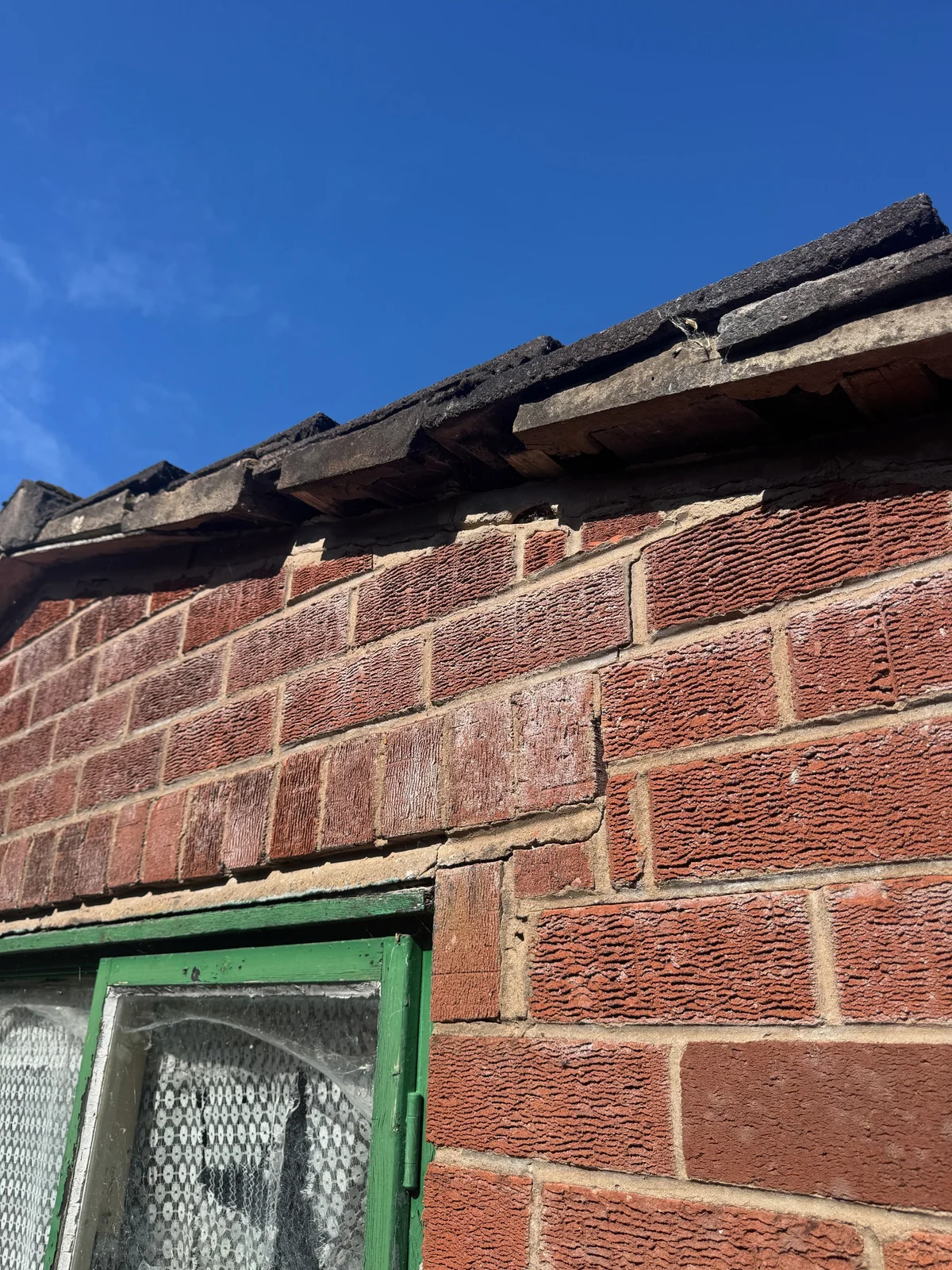
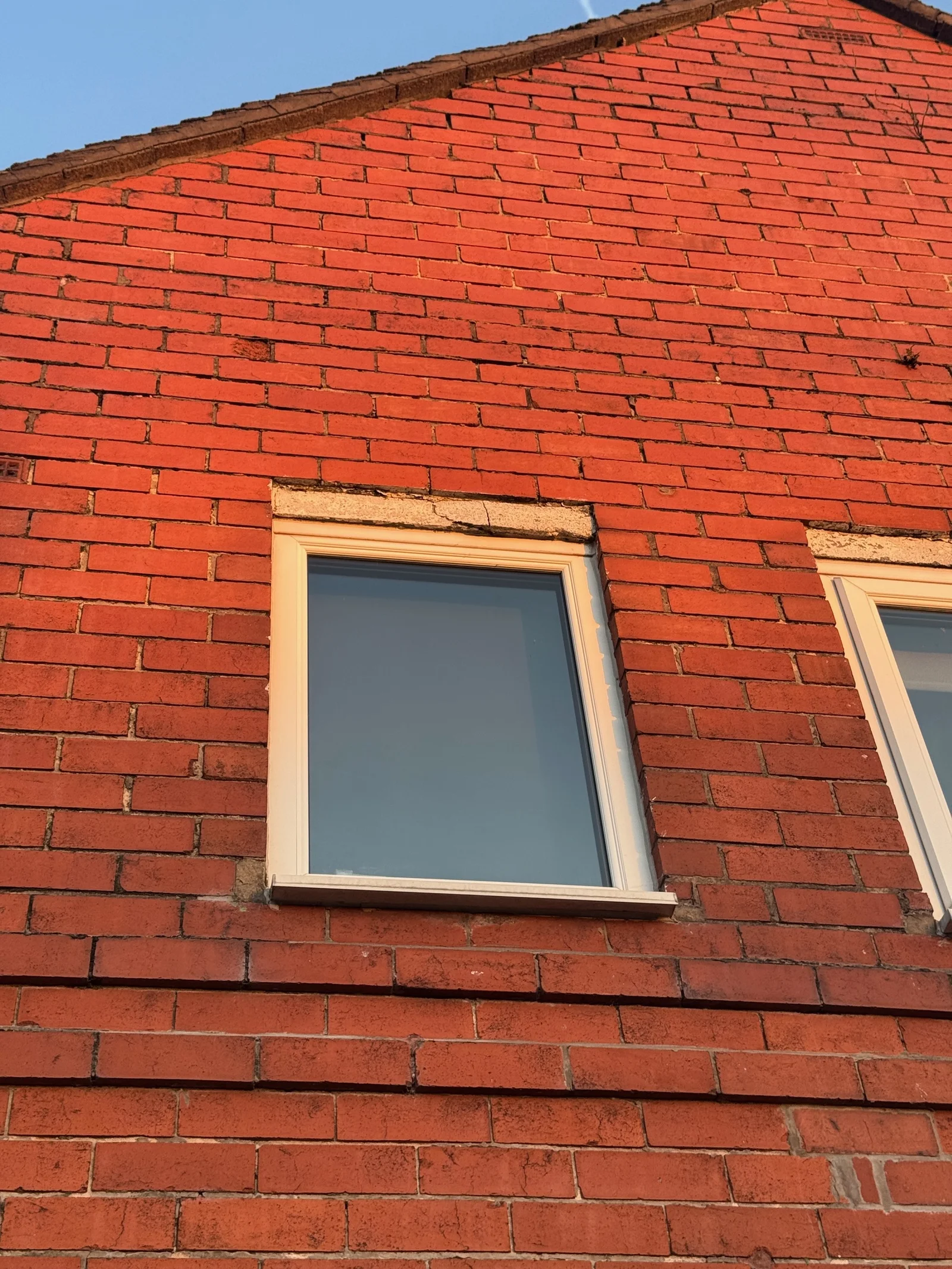
Follow the visible crack route above the opening and note which joints and materials it crosses. The image does not date the movement.
Survey archive photograph · View larger image
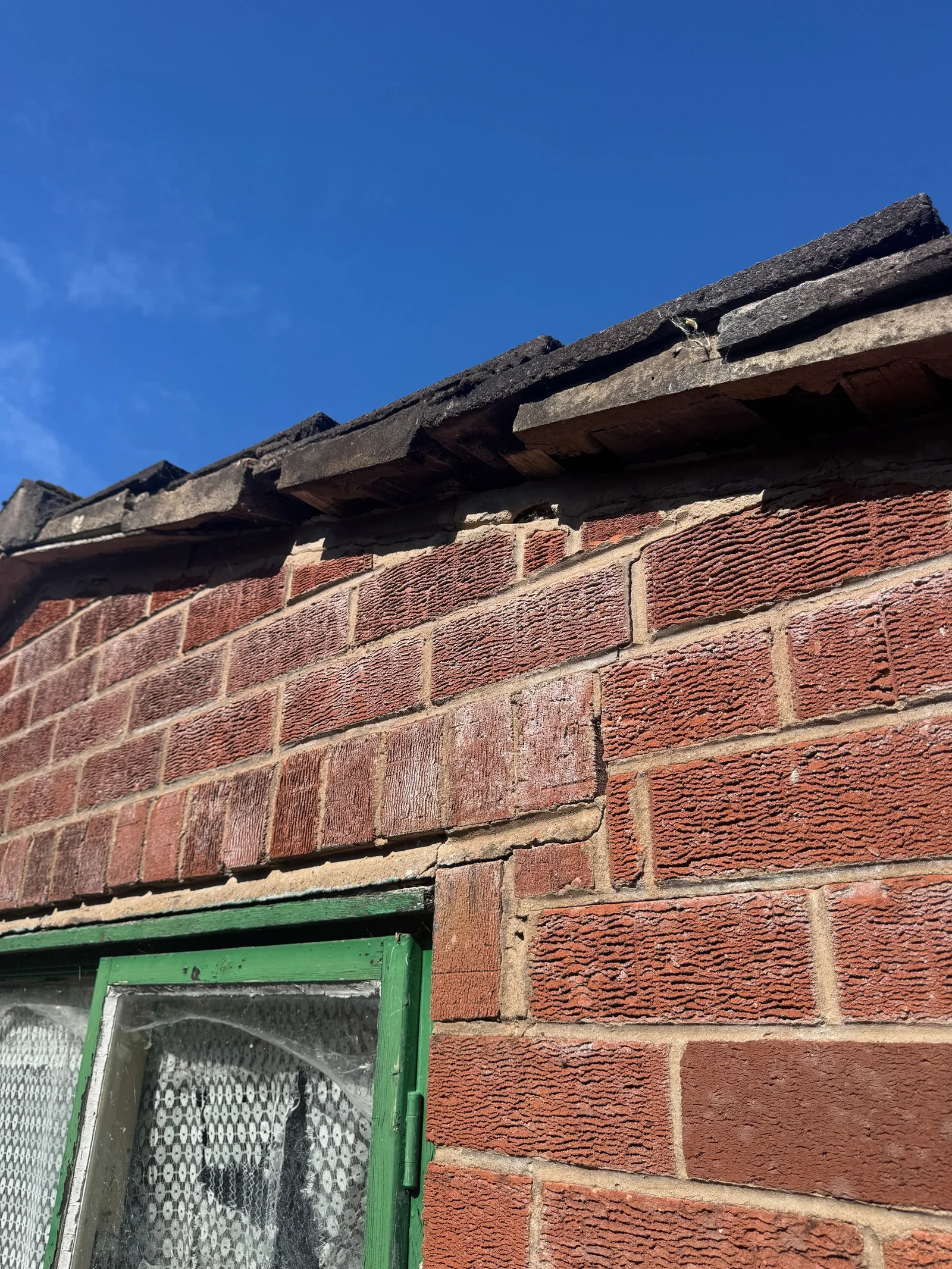
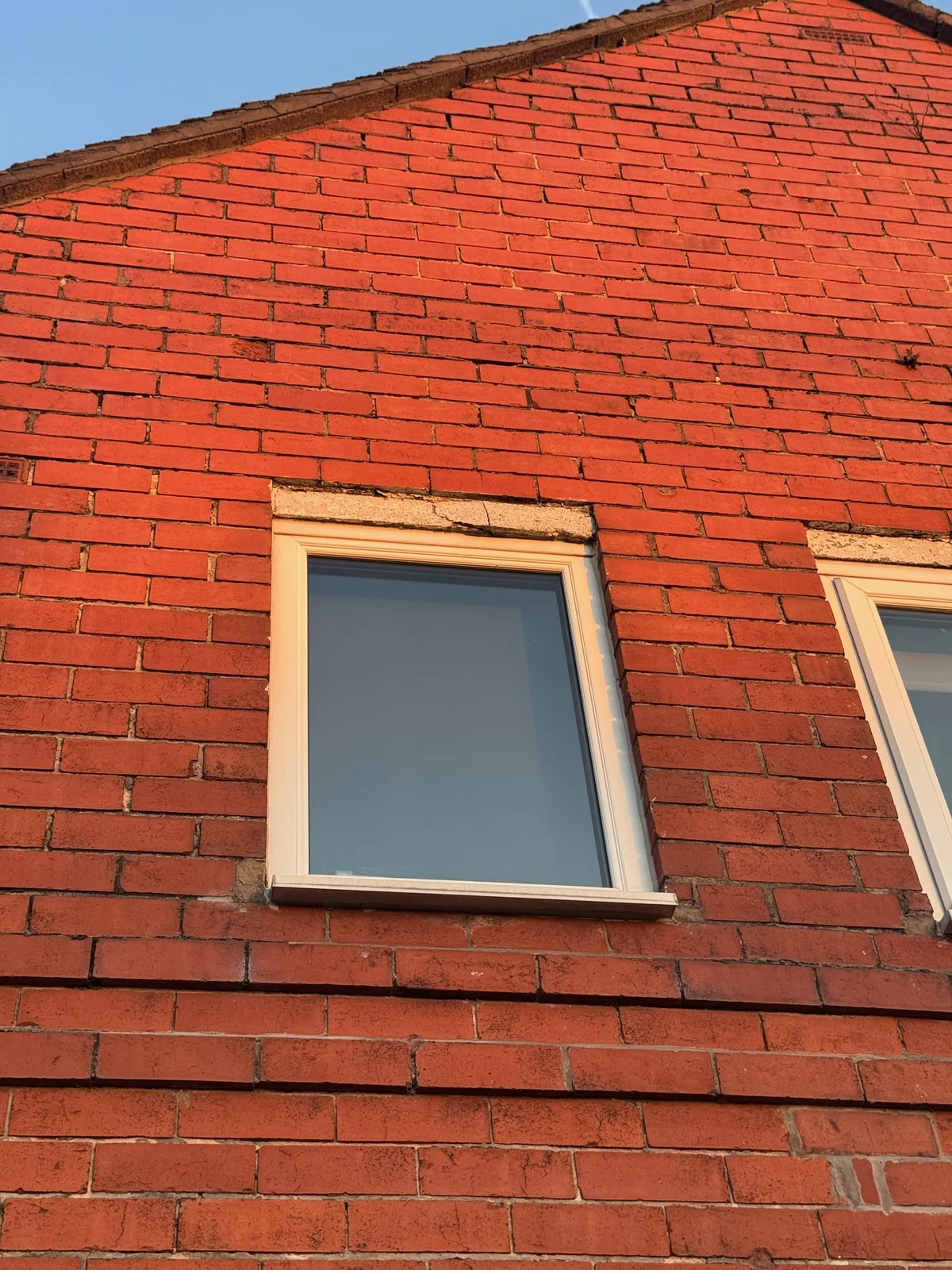
Here the visible crack passes through the lintel. This is a different observation from an open mortar joint; its cause and structural significance require further assessment.
Survey archive photograph · View larger image
What crack width and level readings can tell you
Classification has context. BRE’s account of its low-rise damage research relates crack width and number to repairs, and explicitly warns that its simplified categories require wider assessment, including change over time. Use the actual Digest for a formal classification; this guide supplies no copied category table or automatic width verdict. BRE, Assessing cracks in houses, How cracks are assessed and When to consult a professional.
Ground processes are candidates, not a diagnosis from a map. Clay shrink–swell varies with moisture and material properties; vegetation, drainage changes and leaks can influence it. BGS susceptibility mapping describes potential, not proof of the mechanism at a particular property. Check what the ground record actually establishes. BGS, causes, effects and Hazards potential mapping.
Look above the foundations too. In stonework, SPAB identifies examples including degraded timber lintels and expanding corroded embedded iron. The affected material and connection matter when selecting alternatives to a ground explanation. This reference concerns stone walls, not every structural system. SPAB, Stone walls, problems affecting stonework.
A displayed increment is not the uncertainty. Instrument, object, environment and operator can contribute to measurement uncertainty. Resolution, repeatability and uncertainty have different meanings. A competent monitoring plan must establish whether its method can resolve the change relevant to the decision. NPL, GPG11 issue 2, sections 2 and 4; Annex A.
Describe the building before choosing a mechanism
Identify the affected element, material, construction phase and intended role. Separate known construction from inference. Record openings, bearings, junctions, extensions, earlier repairs and accessible adjoining elements. Show on a plan which interior and exterior observations correspond and which do not. Do not assume two nearby cracks form one continuous fracture through a concealed wall.
Use each visible pattern to identify the evidence needed to investigate it.
| Observation or question | Evidence worth seeking | What must remain open |
|---|---|---|
| Cracking at an extension junction | Construction phases, connection details, corresponding levels and dated history | Whether it is an intended joint, a separation, differential change or a finish detail |
| Cracking around an opening | Accessible support, bearing and frame condition; displacement and continuing route | Whether support behaviour, local material effects or wider movement explains it |
| Cracking and distortion at several connected locations | A plan/elevation relationship, load path and reliable comparison records | Which part is moving, in what direction, and why |
| Damage near drainage or vegetation | Verified layout and condition, ground information and relevant history | Whether proximity represents a causal connection |
| Old filler or decoration across a crack | Attributed repair records, reliably dated images and changes at matched points | Exact damage date, activity since repair and any insurance relevance |
| Apparently isolated finish cracking | Extent of inspected substrate, junction details and limits of access | Whether concealed fabric is affected |
Give change a defensible meaning
For cracks, identify exactly where width was measured, how the edges were defined and the direction of measurement. Different positions along the same crack can give different values. Record uncertainty rather than inventing extra decimal places. Keep raw photographs and readings.
For levels, define the points, datum or benchmark, sign convention and method. Keep raw observations, corrections, closure/check results and a record of changes to the network. Show levels and changes with explicit units. A proposed monitoring brief is not evidence that the benchmark was stable or that the completed survey met its specification.
When comparing campaigns, ask whether the point is the same, the reference remains valid and the method’s uncertainty is suitable. Preserve observations that fail checks, but mark them unusable for the proposed comparison until resolved. Do not silently correct a suspect datum by choosing the answer that best fits the expected trend.
Is 10 mm normal movement
Interpret a dimension in context. First establish 10 mm of what, between which points or dates, relative to what, with which uncertainty, affecting which construction and function. A dimensional tolerance for completed work, a crack category and a project’s monitoring trigger are not interchangeable.
Generic bands for changes in level have not been established for this use and are not adopted here. Where a project has specified triggers, retain their author, rationale, quantity, reference and required response. Do not transplant them to a different building.
Safety and next action
If the observed condition suggests imminent instability or falling material, stop the affected inspection, keep clear and obtain urgent competent assistance; use emergency services where people are in immediate danger. Do not wait for a scheduled monitoring round to address an immediate hazard. This is a precautionary decision rule, not a crack-width classification.
Intrusive investigation or alteration of potentially load-bearing parts needs a competent assessment and appropriate arrangements. HSE’s alteration/demolition guidance assigns temporary-support decisions and design to competent people; this record does not instruct a surveyor to remove support or improvise propping. HSE, Survey and assessment and Preventing structural collapse; scope is alteration, demolition and dismantling work.
For a non-emergency finding, explain the decision that investigation will inform. A useful referral identifies the affected area and function, evidence collected, plausible alternatives, access limits and the specific question for the next professional. Monitoring can answer a defined change question; it should not postpone an investigation or action already justified by the evidence.
From investigation to repair
Distinguish the confirmed defect, the proposed response and the evidence required before dependent repairs. Crack stitching, movement-joint work, drainage repairs, vegetation intervention and underpinning are different responses; a crack photograph alone is not a specification for one of them. Design, sequence, approvals and verification belong with the appointed competent professionals and the particular building.
Record the outcome against the original question. A repaired surface, unchanged gauge and resolved building problem are different outcomes. If the later evidence contradicts the explanation, amend the current advice and the reusable lesson, keeping the earlier record.
Write a clear finding
“At [location], [observed cracking and associated condition] was recorded by [method]. [Dated comparison] establishes [limited finding], subject to [specific limits]. [Mechanism] remains [confidence] because [evidence and contrary evidence]. Arrange [focused investigation or action] to determine [question], with [responsibility and appropriate timing]. Review [result] before [dependent decision].”
Do not report an unverified cause as subsidence, an old repair as a reliable chronology, or a small change as stability. Where advice affects a claim, keep physical evidence and damage history linked to Claimology’s separate event, policy and coverage assessment.