Timber condition involves both the material and the job it performs in the roof. Holes, splits and softened surfaces raise different questions about insects, moisture and the remaining member. Their significance also depends on the position of joints and supports.
Compare the visible forms below, learn the decay and insect terms, then connect the finding to the roof structure before considering treatment or repair.
Start with a description you can defend
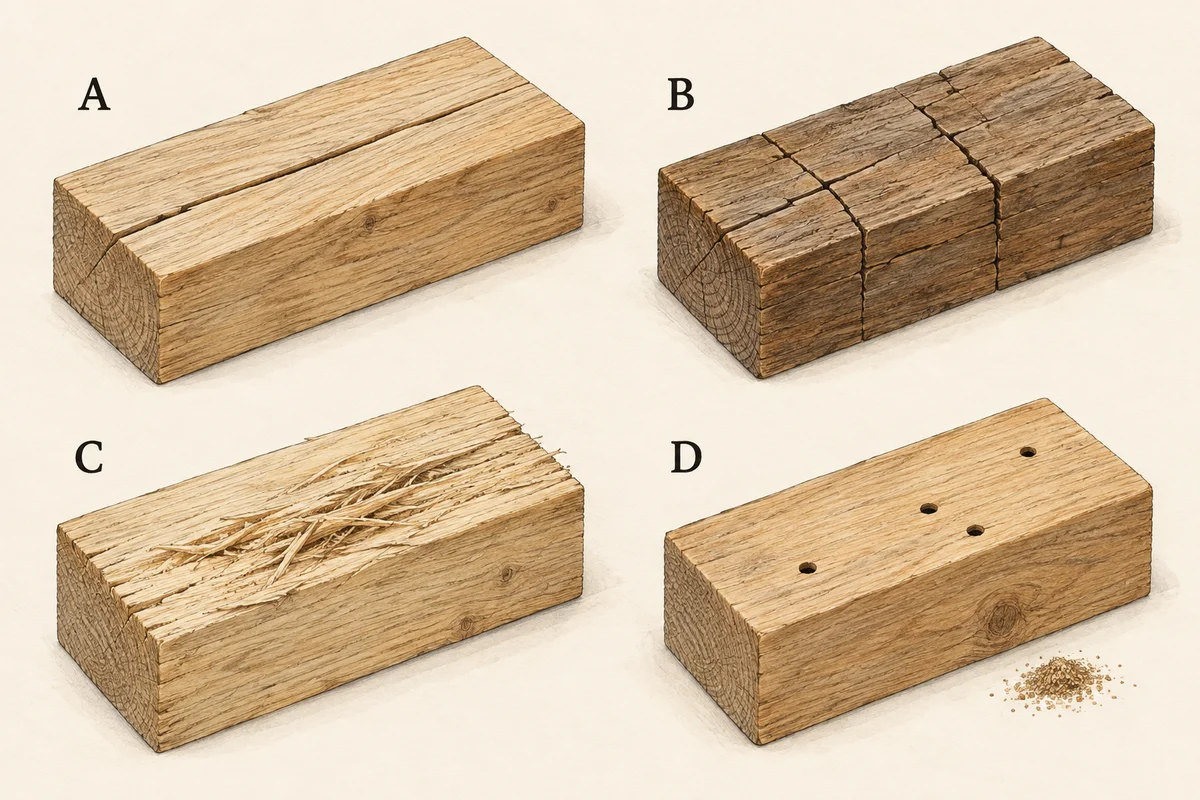
Illustration notes
AI-generated illustration. View larger image.
A · Along the grain
Describe the position, direction and visible extent of a split. Record whether it meets a joint, fixing or bearing. Its cause and structural significance need separate assessment.
B · Block-like cracking
Record intersecting cracks and any missing or friable material. A blocky pattern is a useful observation; it does not identify a particular fungus.
C · Fibrous surface
Describe fibres and surface loss without calling the timber white rot from the drawing. Mechanical splintering can also look ragged; the illustration is deliberately limited to texture.
D · Holes and loose material
Locate and measure real holes with a scale. Keep the observed dust separate from any inference about where it came from or when it was produced.
These are observation prompts, not four diagnoses or stages of one disease. The Engine Shed's timber guidance includes drying cracks among timber characteristics and highlights rafter feet, wall plates and valley-adjacent timber as useful places to examine for damp-related problems. A split is not automatically fungal decay, and appearance does not establish residual strength. [TC05]
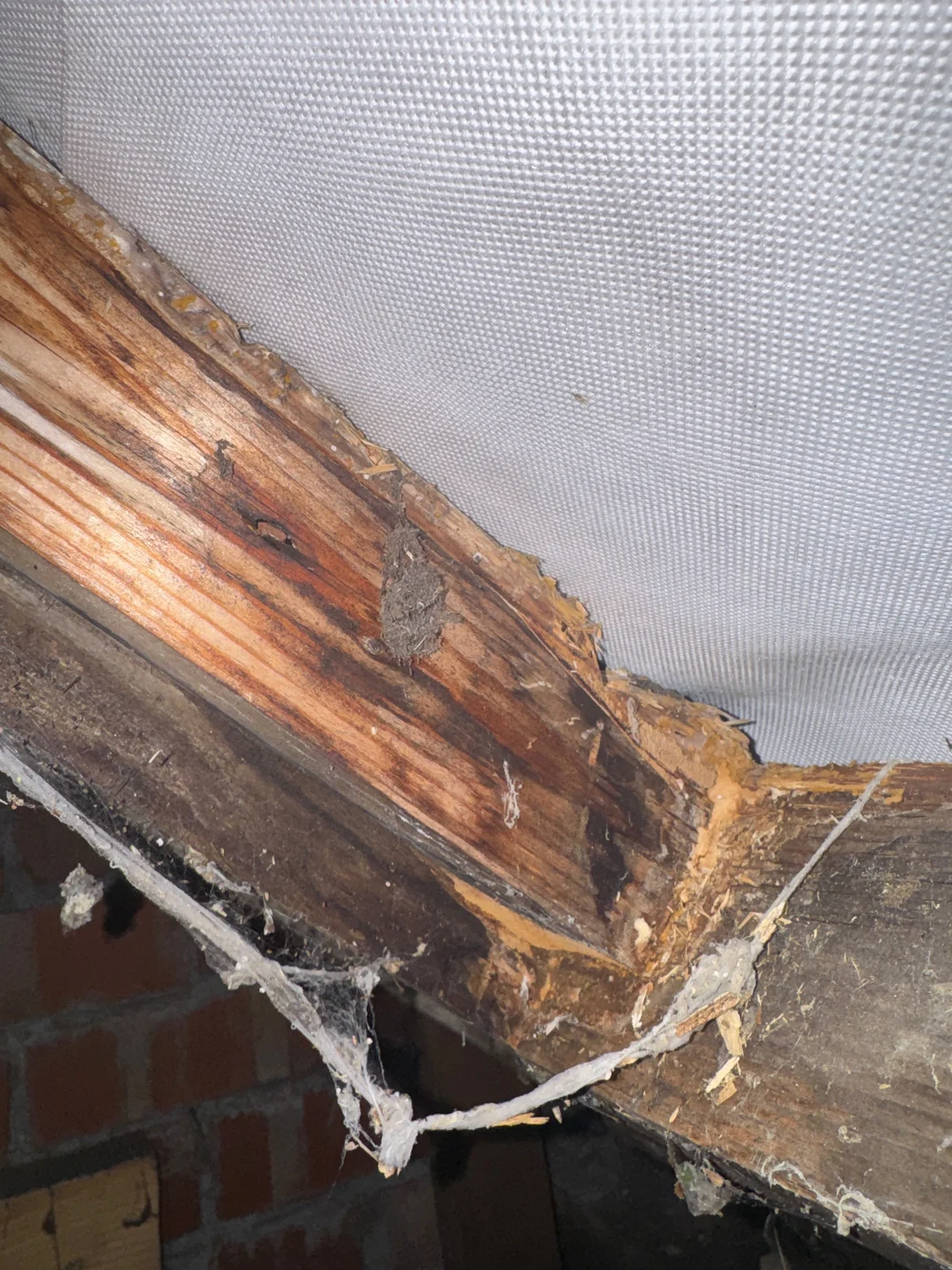
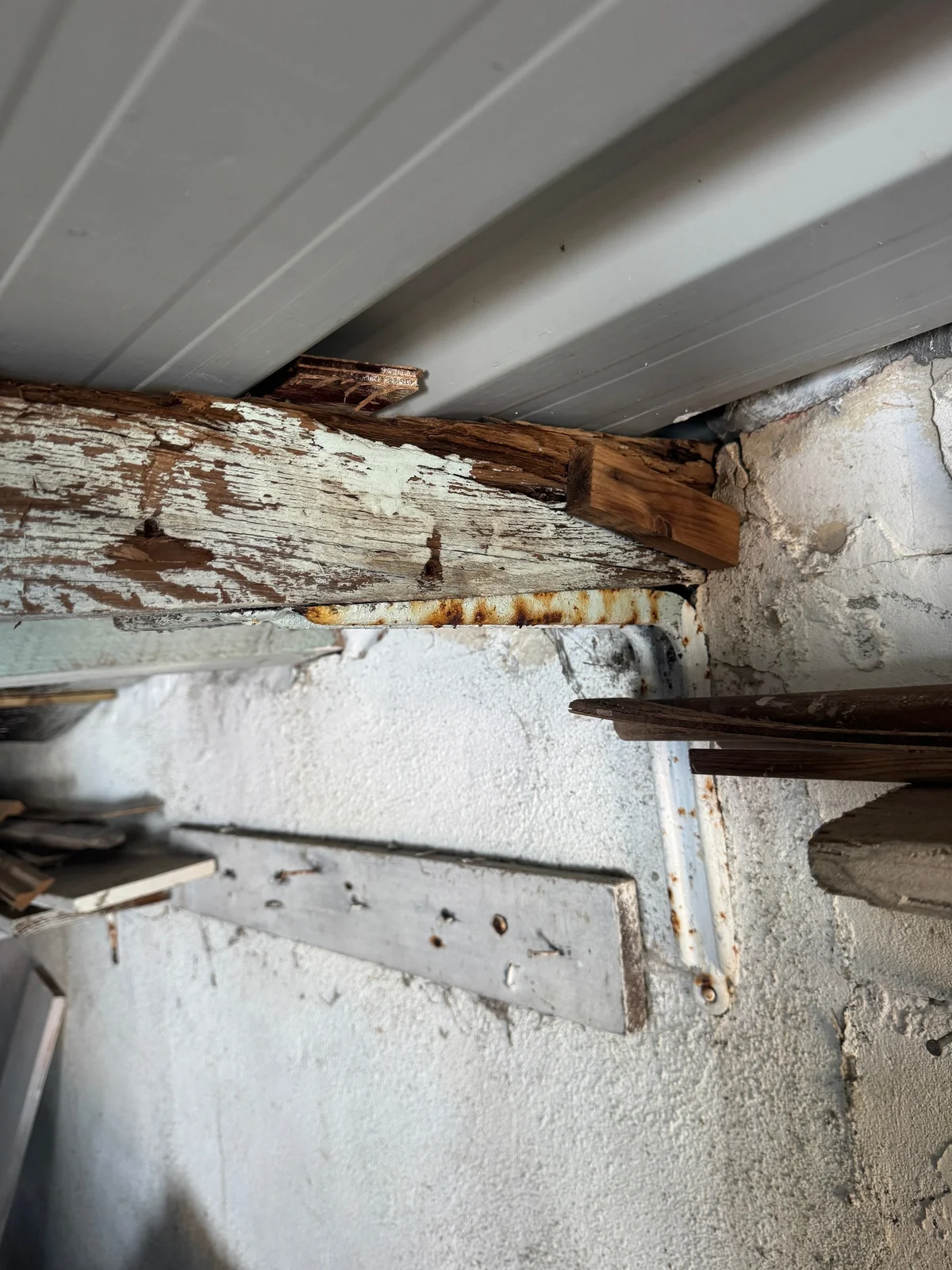
Surface loss and deterioration are visible at this timber junction. Record which member and connection are affected before discussing the significance.
Survey archive photograph · View larger image
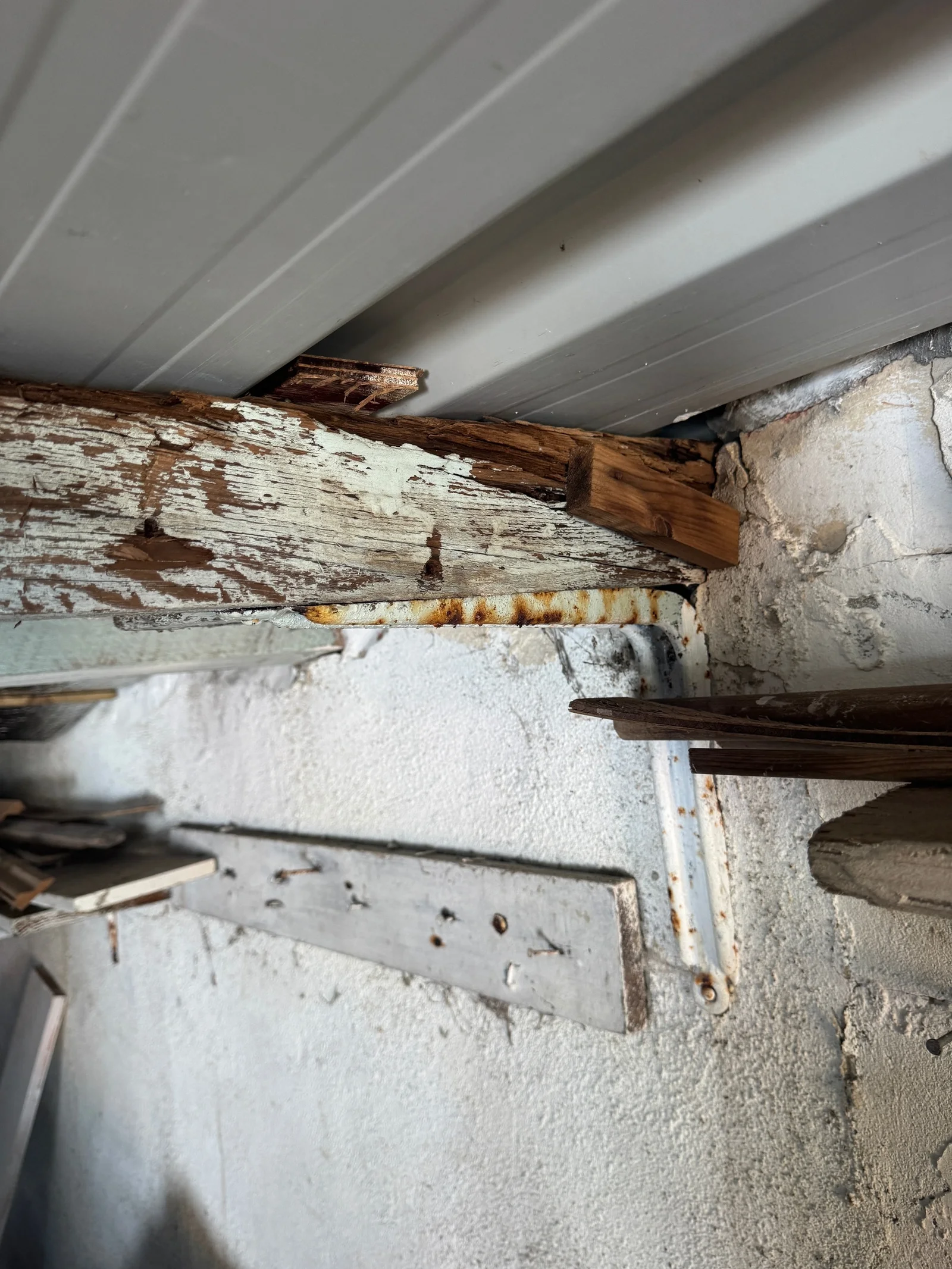
This beam end has a different pattern of material loss. Compare the visible condition, while keeping the concealed bearing and remaining strength as separate questions.
Survey archive photograph · View larger image
Keep the rot terms distinct
Dry rot names decay caused by Serpula lacrymans, a brown-rot fungus. The name does not mean that moisture is unnecessary. Wet rot covers several fungi and can produce brown- or white-rot patterns. Brown-rot damage can show block-like cracking; some white rots leave a paler, fibrous texture. Those categories overlap with the language of appearance but are not interchangeable species labels. The SPAB's fungal-decay guide explains the distinction. [TC01]
For an actual finding, ask whether the identification rests on a competent examination, suitable sample or only a photograph. Record growth, cracking, texture and location separately. Keep the proposed moisture source provisional until investigated. A fungal name alone does not specify the damaged extent or the repair required.
Drying and strength answer different questions.Investigating and controlling moisture addresses conditions for deterioration. A timber that has dried still needs its existing damage and structural role assessed; drying is not a strength certificate.
Holes do not date an infestation
Wood-boring beetle larvae feed within timber; adults may leave emergence holes. Britain's relevant species include common furniture beetle, deathwatch beetle and, in parts of the south, house longhorn beetle. Species, timber and conditions matter. Much visible attack in old buildings is historic, and dust can be dislodged from old galleries by later work. The SPAB's insect guidance supports careful activity assessment and monitoring where signs are ambiguous. [TC02]
Use an evidence ladder rather than a yes/no label:
| Evidence available | A defensible statement | Still to establish |
|---|---|---|
| Holes in one photograph | Holes are visible in this face | Origin, dimensions, extent and date |
| Loose dust beneath a member | Loose material was present at this location and visit | Whether it came from that timber and whether it is newly produced |
| Repeated located photographs | A particular area can be compared over time | Whether lighting, cleaning or building work explains the change |
| A specialist's identified specimen or monitored event | Attribute the identification and evidence to the report | How far it applies across the roof and what action is justified |
Do not convert an unmeasured hole diameter, dust colour or apparent freshness into a certain species/activity finding. Monitoring should answer a defined question over a suitable period, with earlier evidence preserved.
Read moisture measurements in context
A resistance meter infers timber moisture from electrical resistance at its electrodes. Readings can vary within one member and with species, temperature, electrode arrangement and previous surface treatments. More decimal places do not remove that uncertainty. Historic England's July 2026 moisture-investigation guide, printed pages 41–44, explains these limitations. Preserve the mode, setting, locations and measurement method with the result. Do not treat a non-timber display scale as a verified percentage for wood. [TC03]
Surface is one location
A shallow reading records a local response. It does not measure an inaccessible bearing or the whole cross-section.
Time is part of the evidence
Keep visit date, conditions and relevant recent events. A single visit cannot establish a seasonal pattern or prove that an earlier leak has remained resolved.
Brian Ridout's Historic England report 207/2020 analysed monitoring in three medieval roofs. Some old timbers showed high winter surface readings with more stable readings deeper within; variation also occurred between members. The study warns against diagnosing deterioration from a simple threshold alone. Its historic-roof findings are not permission to dismiss elevated readings in a modern leaking loft. They support investigating context, depth and duration where justified. [TC04]
The SPAB uses below 20% as a practical drying aim for fungal control. That is not a universal boundary between sound and rotten timber, nor proof that decay exists whenever a meter exceeds it. Read that maintenance guidance alongside the research's scope and the actual building evidence. No treatment or repair decision here depends on one percentage. [TC01, TC04]
Connect the finding to the member
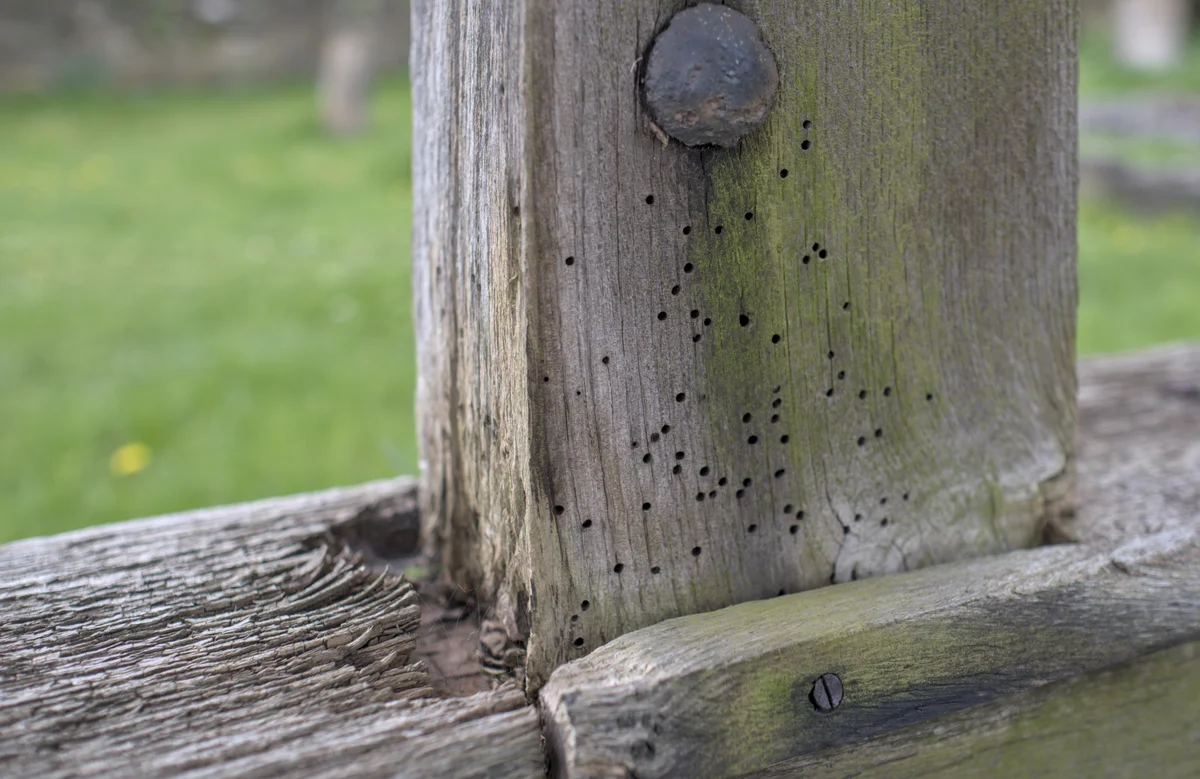
“Church of St Mary: woodworm and decay” © Bob Harvey, CC BY-SA 2.0, via Wikimedia Commons. Display copies resized and converted to WebP; no crop or annotation. Adapted copies retain the same licence. View larger image.


The photograph provides a real British comparison for surface observations. A roof-space enquiry must then connect its own detail to the member, joint and support. Use the roof-structure guide to keep that relationship visible.
| Question | Useful evidence to seek |
|---|---|
| Where is the affected area? | Located overview, member ID and detail; accessible faces and concealed ends marked |
| What changed or may still be changing? | Dated observations, previous photographs, repair history and a defined repeat-inspection plan |
| What moisture route needs testing? | Matching roof, rainwater, service or internal-moisture observations; alternatives retained |
| What remains of the member or joint? | Competent assessment of extent and residual section where the decision requires it |
| What decision is needed now? | Safe access/use, further investigation, moisture repair, monitoring or structural design — with an owner and timescale |
These prompts organise the next enquiry; they are not a calculation method. A suspected damaged support deserves a different response from unexplained holes in accessible non-structural joinery. Stop the relevant inspection activity and seek prompt competent advice where apparent instability or significant support deterioration makes continued access questionable.
Plan repairs across moisture, structure and thermal performance
The SPAB prioritises correcting moisture and proportionate repair; chemical treatment is not a substitute for addressing the wetting source. Avoid choosing wholesale replacement or treatment merely from the illustrations. [TC01]
For proposed work in England, Approved Document C, 2004 edition incorporating 2010 and 2013 amendments, covers moisture resistance. C2 and paragraph 6.2 connect roof weather protection with condensation and structural/thermal performance. This is guidance for applicable work, not a retrospective pass/fail test for an old timber. Check the work classification, applicable edition and transition position with the building-control/design team. The document's older references are not confirmation that every cited standard remains current. [TC06]
Structural changes link to the Part A discussion. Where the work changes insulation or a thermal element, follow the scoped Part L and roof-space guidance and insulation evidence guide. Use the guidance applicable to the proposed work and building.
Use the national route for the project: Welsh Approved Document C, Scottish domestic technical handbook or Northern Ireland Technical Booklet C. These are signposts, not a clause-by-clause comparison. [TC09–TC11]
Turn this into a located record with Inspect timber condition.