A bathroom fitting is more than its visible ceramic shape. A basin has a mounting arrangement, a waste and a support; a WC combines the pan, flushing system and soil connection. Understanding those parts makes identification and repair much more precise.
Six ways a basin can meet its surroundings
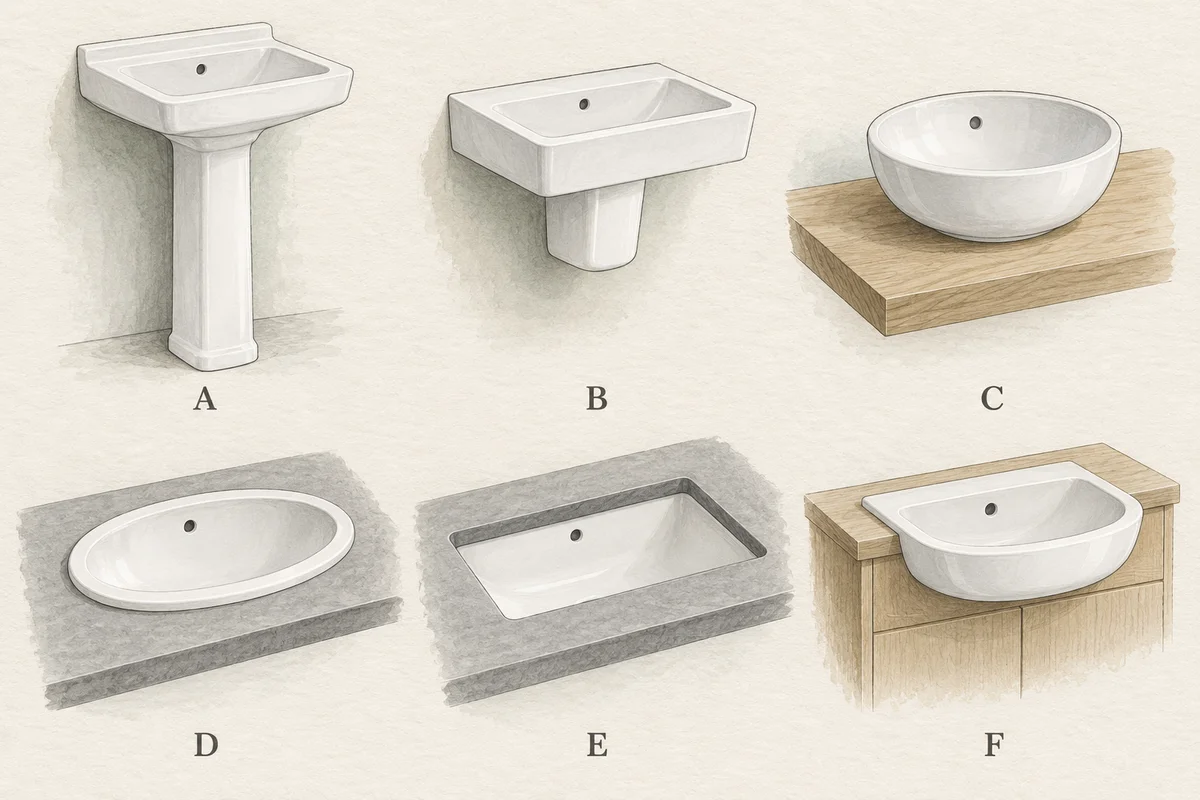
Illustration notes
AI-generated illustration. View larger image.
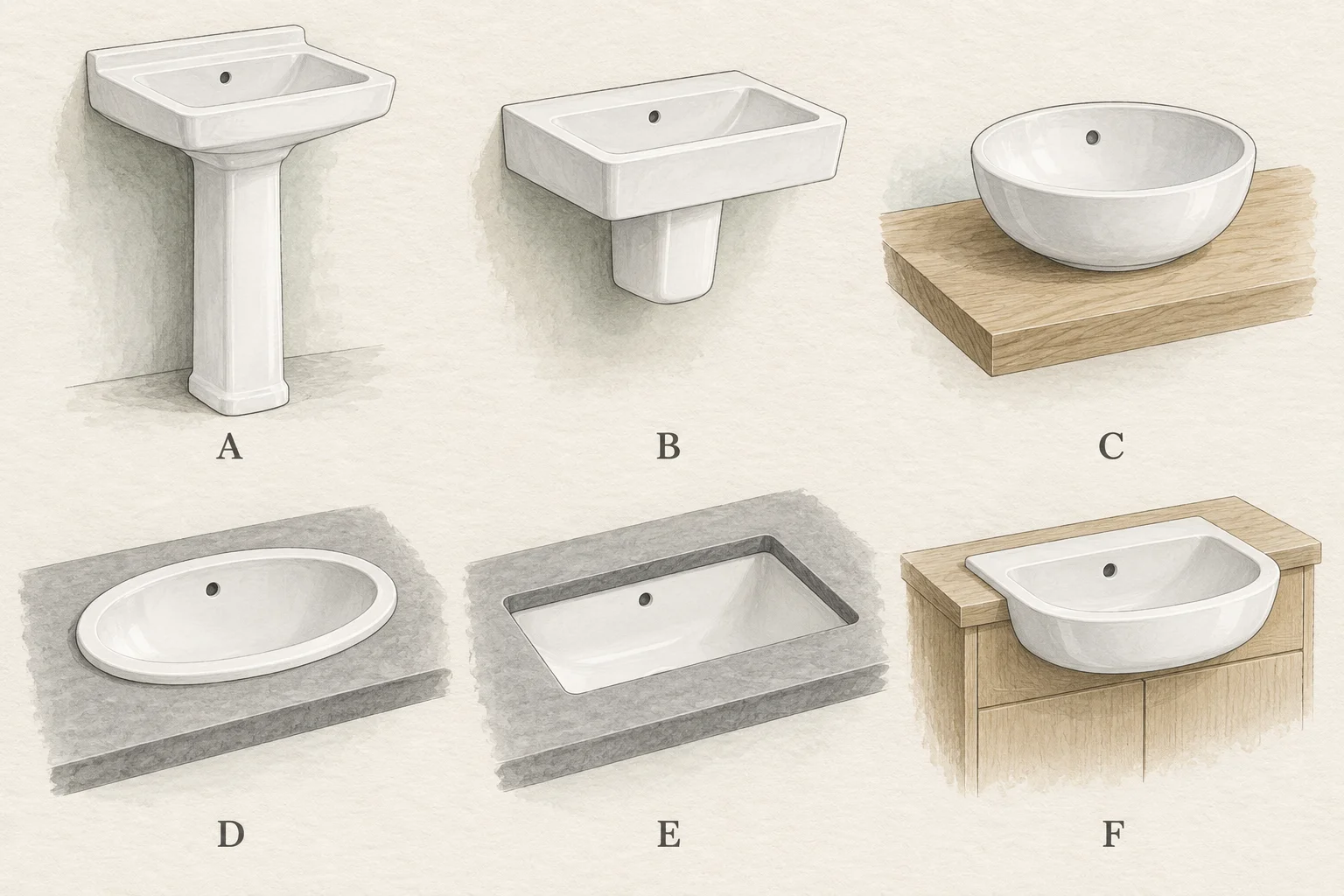
A full pedestal reaches the floor; a semi-pedestal stops above it, generally hiding pipework beneath a wall-mounted basin. Do not assume that either is the sole support. The basin may rely on wall fixings, brackets, a frame or a combination prescribed for that model.
A countertop / vessel basin sits above the work surface. An inset basin has a rim overlapping the opening. An undermount basin fixes below, leaving a finished counter edge exposed. A semi-recessed basin projects forward from a shallow cabinet. Ideal Standard's Sandringham 21 E8961 is a named semi-countertop example with specified securing clips and a sealed joint. SAN01
An integrated furniture basin can form the whole top of a vanity. A washstand basin may sit on an open frame; a wall-hung basin can leave the trap visible. These descriptions say how the fitting is arranged, not whether it is ceramic, metal or a composite.
Material, tap deck and working space
Vitreous china is a glazed ceramic used for many basins and WC pans; E8961 is one documented example. Other basins use cast mineral/resin products, solid surface, glass or metal. Confirm the actual specification before using a cleaner or choosing a repair method. A white finish is not material identification. SAN01
The tap arrangement may be two pillar taps, a monobloc through one hole, a three-hole mixer set or a wall-mounted spout. Check hole arrangement, reach and the usable space behind the bowl. A taller vessel basin changes the relationship with a standard tap and counter height. A replacement with the same outside width may put its waste or tap holes somewhere else.
The overflow and waste must work together
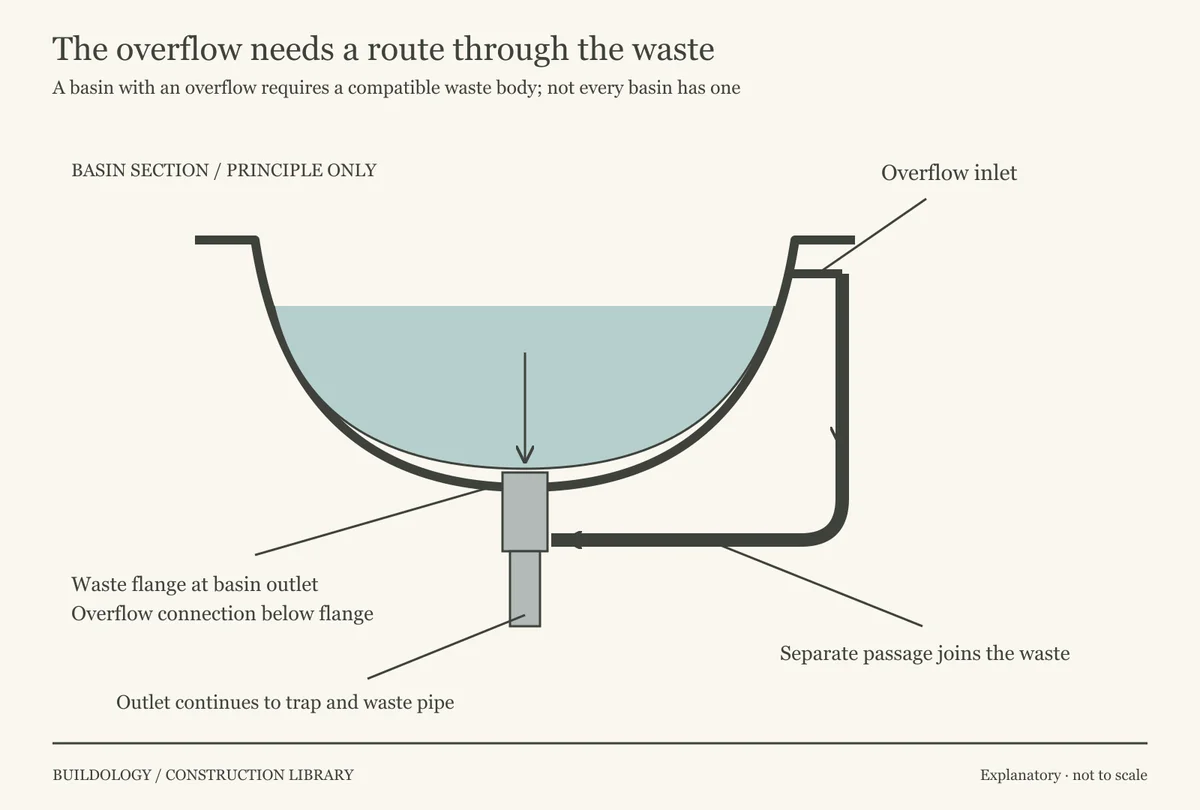
Illustration notes
Original explanatory diagram. View larger image.
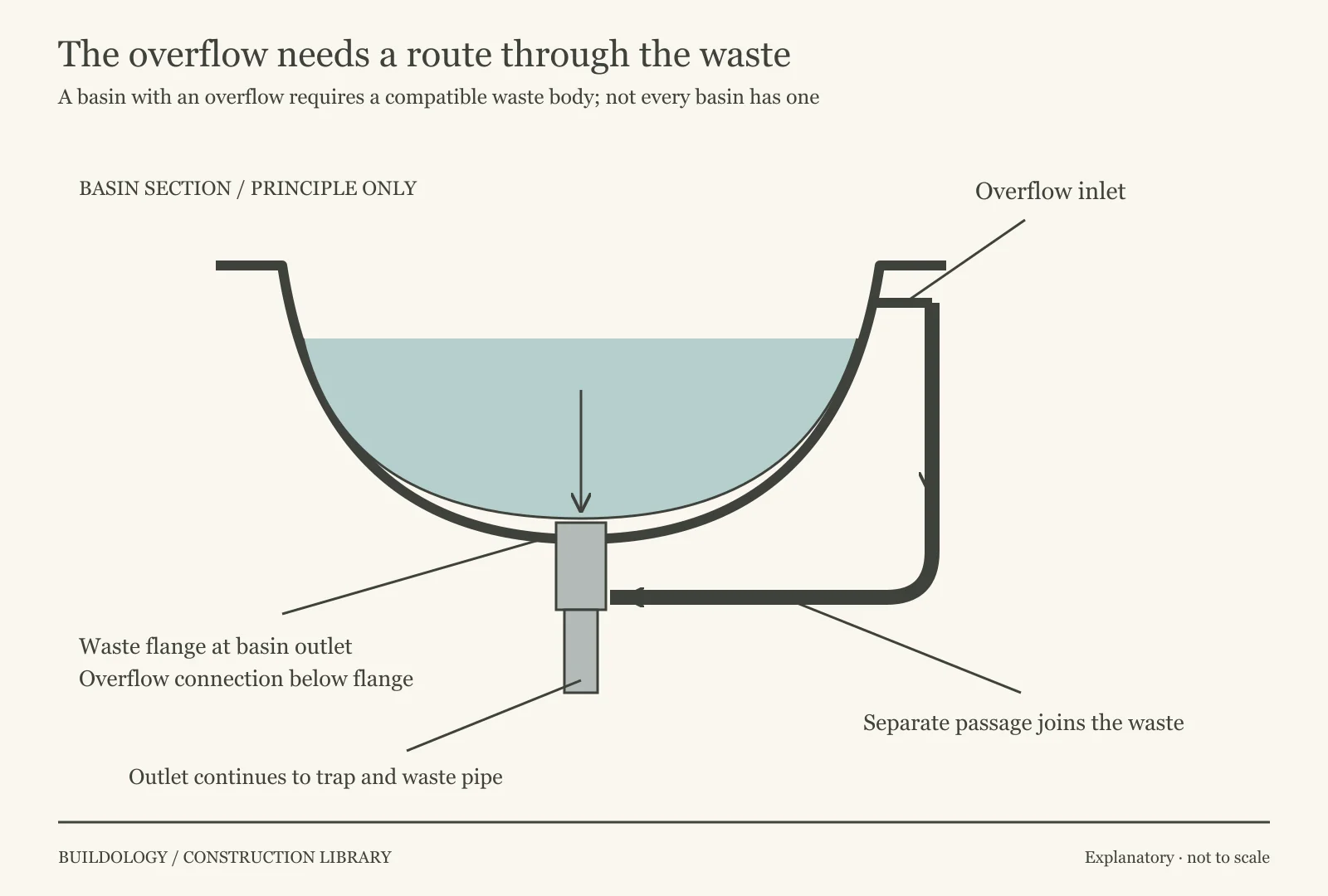
The overflow is a higher opening in the bowl connected to a passage or pipe. In many basins that passage leads to the waste below the flange. A slotted waste provides an entry for this water; an unslotted waste does not. McAlpine supplies both types, and identifies its unslotted free-flow model for basins without an overflow. SAN02, SAN03
Do not select the waste by the appearance of its plug alone. A clicker, pop-up, swivel or plug-and-chain describes operation. The body still has to suit the basin's overflow arrangement, thickness and sealing surfaces. A permanently open waste cannot hold a basinful of water in the way a closing plug can.
An overflow is a secondary route, not a guarantee against flooding from an unattended tap. Its condition, the waste and the downstream pipework all matter. A blocked passage can be hidden even when the opening looks clean.
The trap below the fitting retains water to separate the room from drain air. Bottle traps, tubular P-traps and other arrangements have different shapes and access points. A bottle trap is not a waste fitting, and an overflow is not a trap. For drainage design in England, use the applicable Approved Document H route and the fitting's instructions. SAN04
Distinguish the WC pan from its cistern
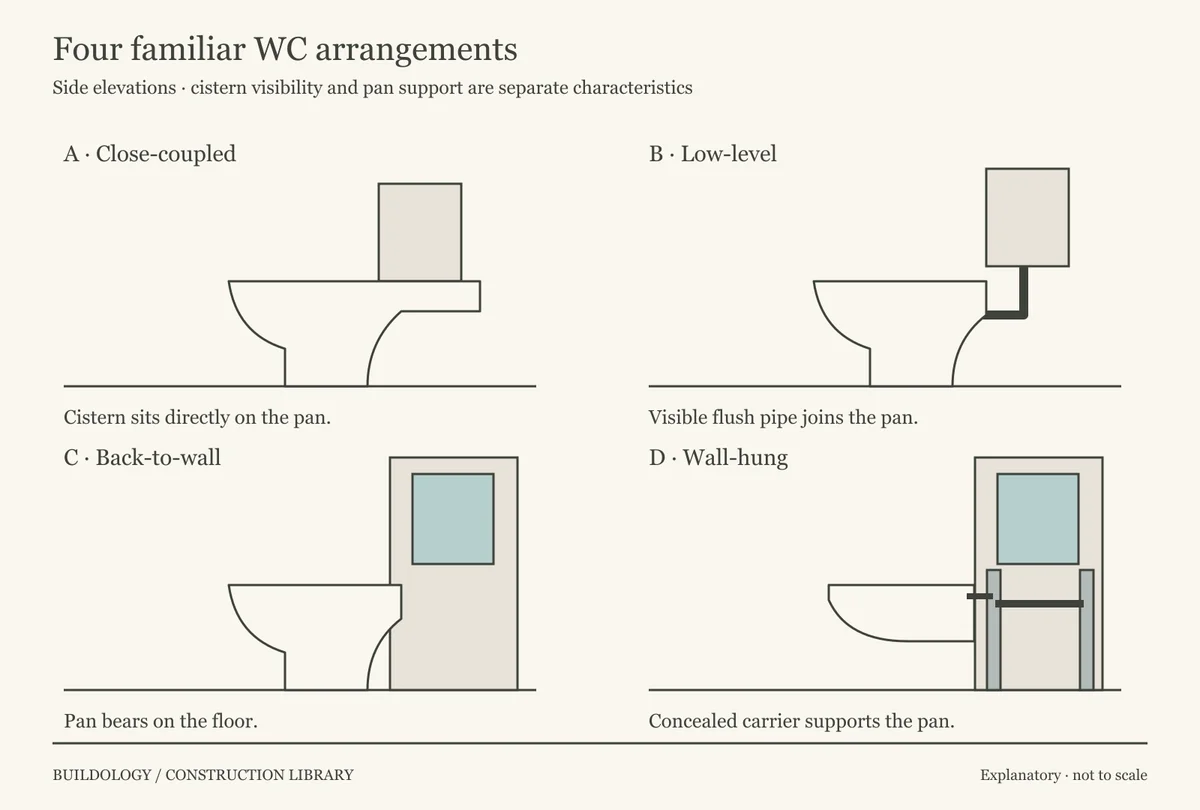
Illustration notes
Original explanatory diagram. View larger image.
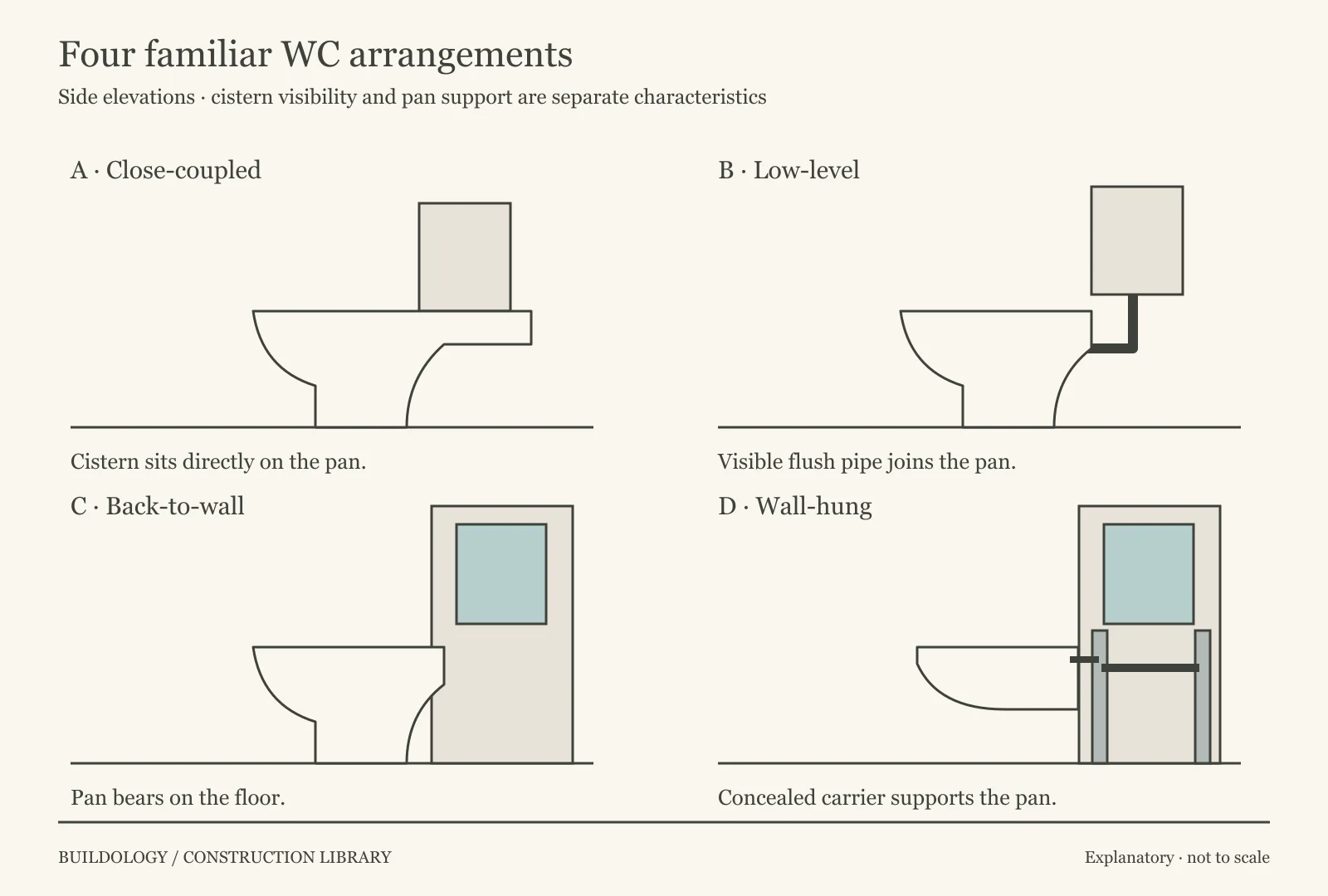
| Arrangement | Visible relationship | Replacement implication |
|---|---|---|
| Close-coupled | Cistern mounted directly on the rear of the pan | Matching contact faces, seals, bolt positions and the approved pan/cistern combination matter. |
| Low-level or high-level | Separate cistern connected by a flush pipe | The pipe arrangement, flushing characteristics and compatible pan need checking. |
| Back-to-wall, floor-standing | Pan meets furniture or a service wall; cistern is often concealed | The floor supports the pan. Access to cistern and connectors may be separate. |
| Wall-hung | Pan projects from the wall with clear floor beneath | Loads require the specified structural support and fixings behind the finish. |
A rimless pan describes the flushing geometry around the bowl, not its mounting. A comfort-height product describes a dimensional choice, not automatic suitability for every user. Seats are not universally interchangeable: outline, hinge centres, top/bottom fixing and release mechanism all matter.
A concealed cistern is a reservoir hidden behind furniture or lining. It does not by itself support the pan. Geberit provides matched installation elements for different wall constructions, with cistern maintenance access through the actuator opening. The product's stated performance still depends on correct installation; a frame rating is not proof about a concealed installation in an existing house. SAN05
What happens inside a cistern?
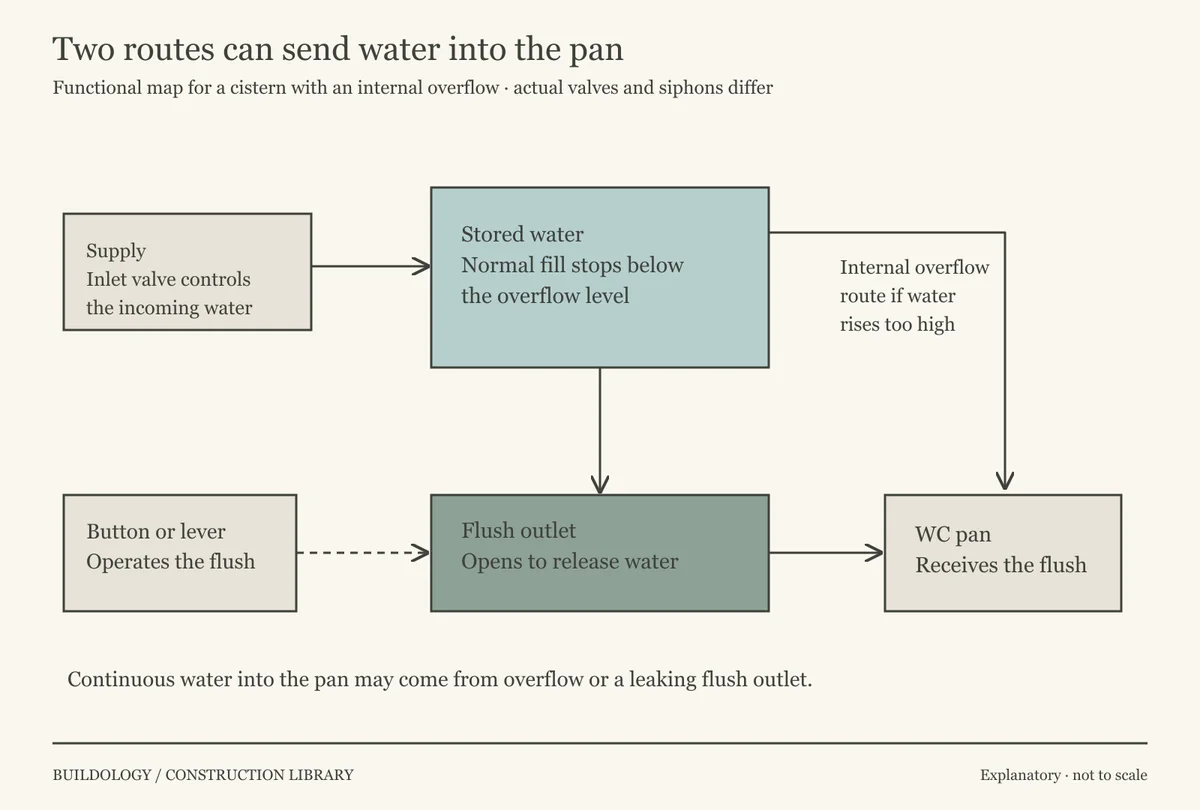
Illustration notes
Original explanatory diagram. View larger image.
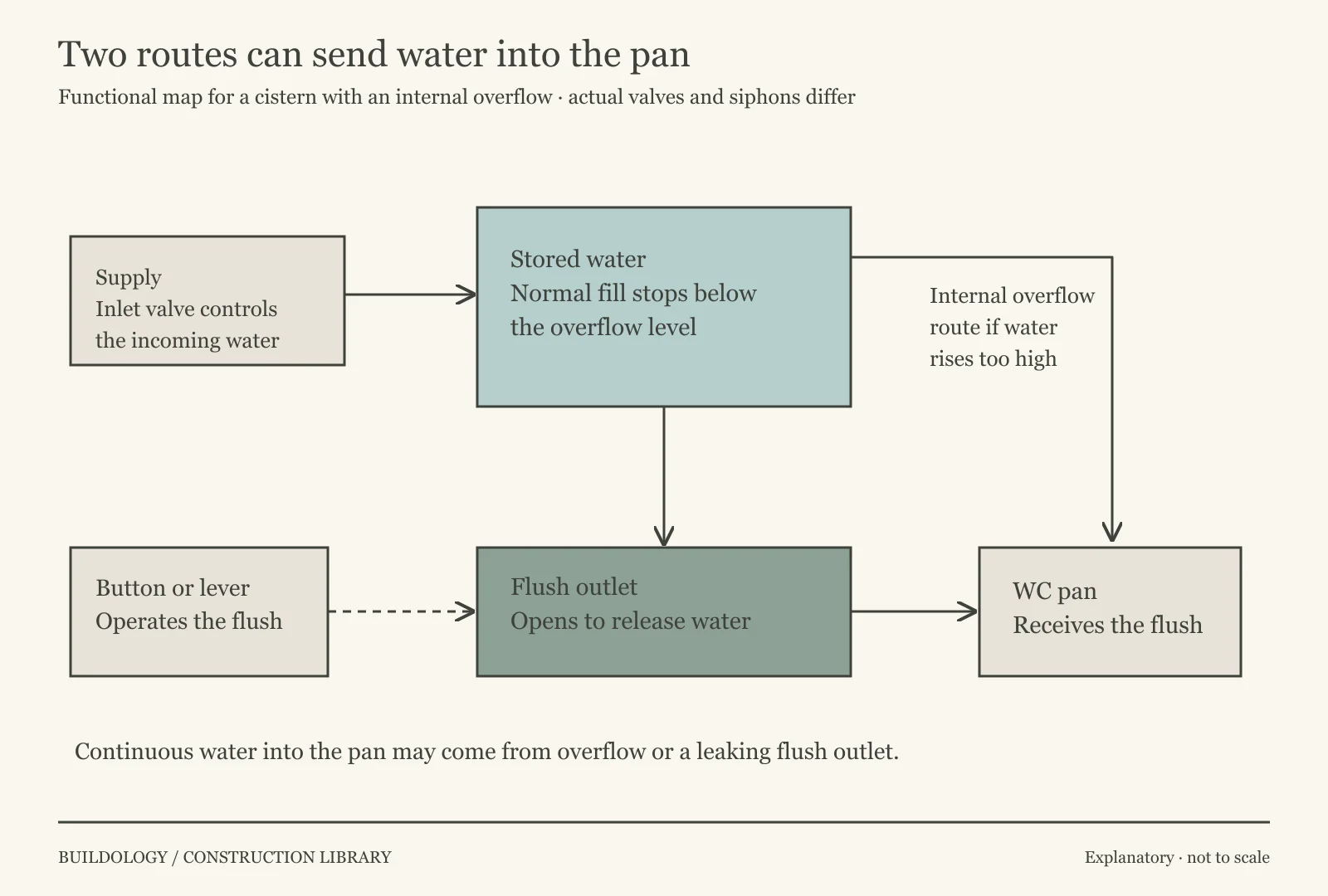
The fill valve admits water and stops at a controlled level. The flush mechanism releases the stored volume towards the pan. The actuator is the lever, button, cable, rod or pneumatic control that initiates the flush. The overflow provides a route if the water rises too far. Those are separate functions even when several parts share one moulded assembly. Geberit's range distinguishes fill and flush components. SAN05
A siphon starts a flow over a raised internal passage; a drop/outlet valve opens a seal at the cistern outlet. A lever does not necessarily mean single flush: Dudley's Turbo 88 provides a reduced flush through a particular lever operation and incorporates an internal overflow. Its quoted siphon size refers to the spillover height, not the total overall height. SAN06
The flush volume, pan and mechanism must be compatible. Arbitrarily altering the water level to save water can affect performance; use the identified system's permitted settings. A short or weak flush could involve actuation, filling, an obstruction or a mismatch, rather than a defective pan.
A new flush plate is not just a cosmetic match
Geberit explains that the concealed cistern family determines plate compatibility: its Sigma and Omega systems are not interchangeable simply because the plates look similar. Establish the existing family and model before ordering. An accessible service opening can permit component replacement without removing the surrounding tiles; it does not make every concealed pipe or failed frame accessible from that opening. SAN07
Separate the common water and movement findings
Water continuously entering the pan can follow more than one route. A fill valve that fails to stop may drive water through an internal overflow; an outlet seal may leak below the overflow level. Observe the actual water level and mechanism through appropriate access before identifying the faulty component. Dudley's explanation of internal overflow helps distinguish that route from the ordinary flush. SAN06
Water on the floor has other possibilities: supply or cistern connections, the pan connector, water splashed during use, or condensation on cold surfaces. The timing and location help direct inspection, but a puddle alone does not establish which joint failed.
A moving basin or WC needs attention to its fixings and supporting construction. Do not use extra sealant as the structural repair, or tighten fixings indiscriminately against brittle ceramic. A crack, loose wall-hung fitting or damaged support warrants restricting use and suitable professional assessment.
For proposed sanitary work in England, Approved Document G addresses provision and washing facilities, while H addresses drainage. Their application depends on the building and work; an existing fitting's style or age is not a compliance verdict. Other UK nations have separate requirements. SAN08, SAN04
Make a replacement description useful
“White basin” or “standard toilet” rarely identifies a compatible replacement. Record the material/type where established, mounting arrangement, actual dimensions and the important connections. For a basin, that may be the counter opening and overflow; for a pan, outlet position and access to fixings; for a cistern, its family and mechanism.
The level of detail follows the task. A sound fitting in an ordinary survey does not need a dismantled parts inventory. A replacement quotation or recurring leak investigation does need enough information to avoid ordering incompatible components.
Does a running WC need a new suite?
Hypothetical example SAN-01. A concealed-cistern WC runs intermittently into the pan. The ceramic is sound and securely mounted. Someone proposes replacing the pan and breaking out the tiled wall because “the cistern is hidden”.
Follow the component rather than the appearance
Find the access and identity. Locate the intended service opening and establish the cistern family. The plate design alone may be insufficient. SAN07.
Distinguish filling from outlet leakage. A competent plumber can assess the water level, overflow route and outlet mechanism. A sound pan does not become defective because a valve needs servicing.
Choose the proportionate work. Compare compatible component repair with any demonstrated access limitation. Tile removal may sometimes be necessary, but it should follow the actual failure and construction, not the word concealed.