Three floors can look like oak while being solid timber, engineered timber or printed laminate. Their different layers affect wear, moisture response and repair. Learn to distinguish the surface material, how it is fitted and the condition you are investigating.
This guide covers common finishes in British homes. Use ground, wall and floor junctions for the supporting floor; detailed tiling and wet-room waterproofing need their own design and installation guidance.
A floor is more than its visible finish
Read the build-up from the walking surface down: finish → fixing or supporting layer → prepared background → supporting floor. Some layers may be absent or combined. A substrate is the surface receiving the next material; name the interface rather than simply writing “poor substrate”. A screed is a layer used to form a floor surface or receive a finish; its presence does not identify the structure below.
Bonded flooring is adhered to its background. A floating covering rests over the background without being bonded across it; connected boards or planks act together. Mechanically fixed timber uses a different fixing arrangement. These terms describe installation, not material identity. “Click” describes a joint, while “herringbone” describes a layout. Neither proves what the wearing surface is made from. [FL01, FL06–FL07]
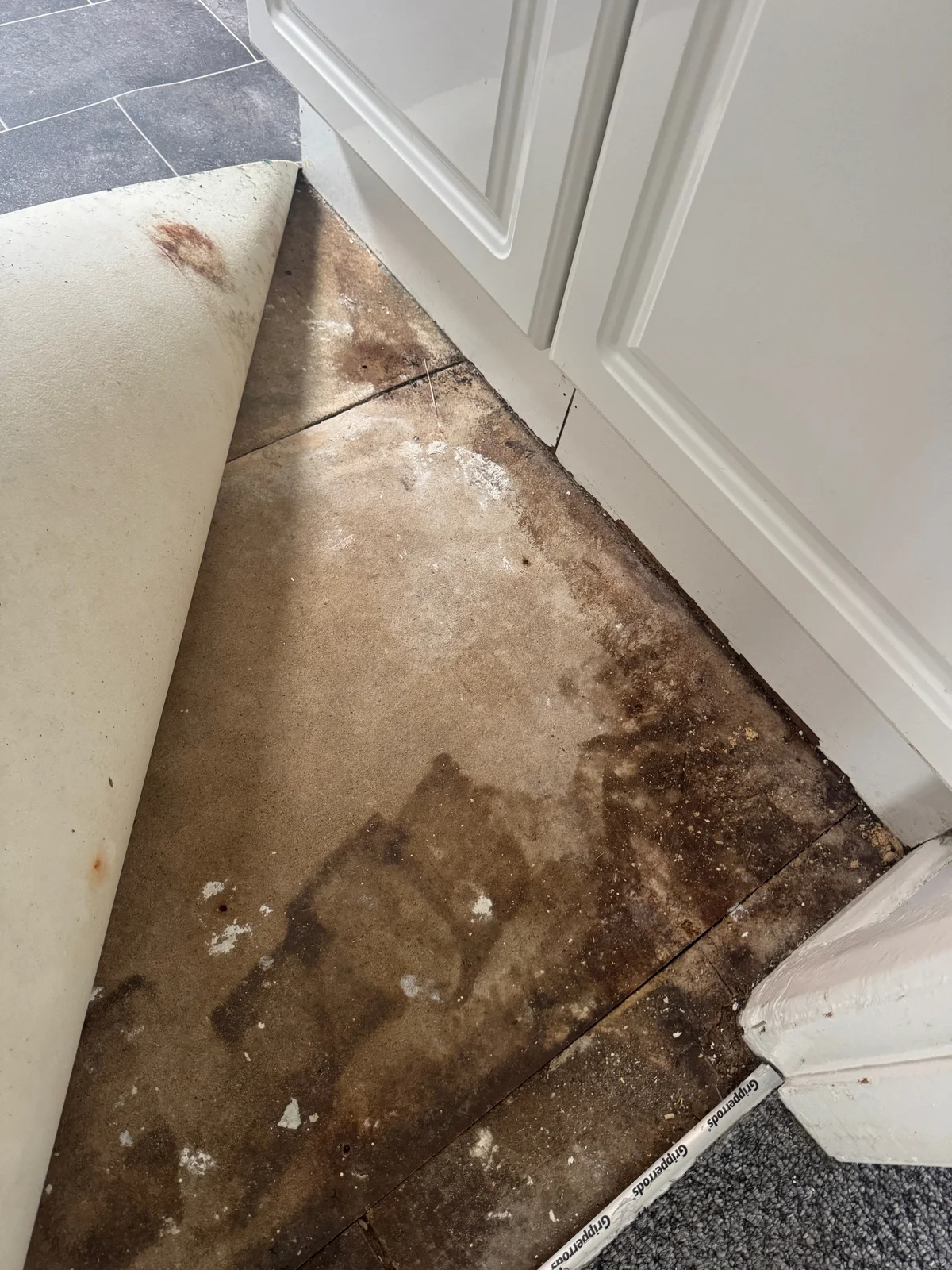
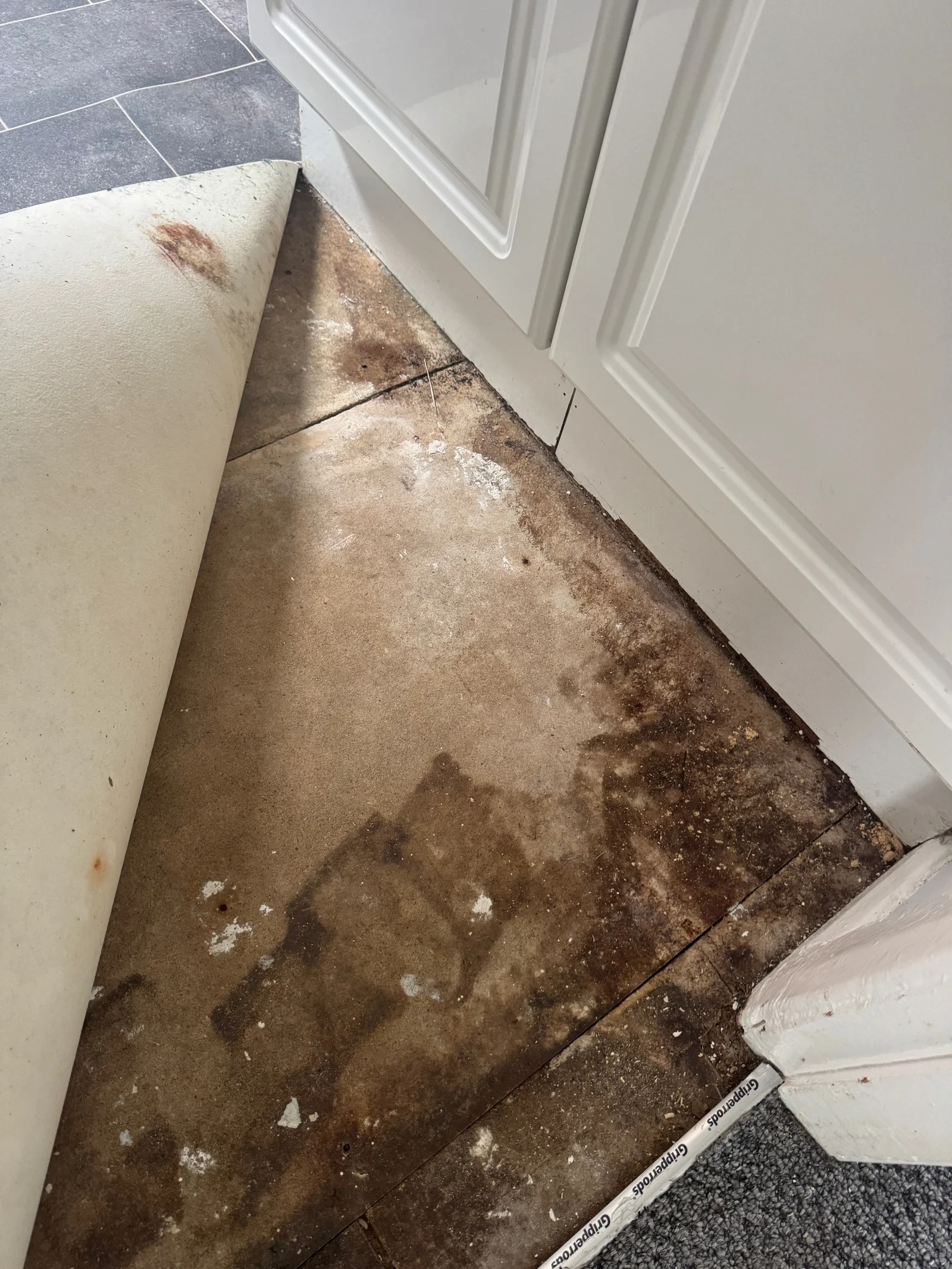
An already turned-back covering reveals staining on the surface below. Describe the covering, exposed background and location separately. Neither the current moisture condition nor its source is established by this photograph.
Survey archive photograph · View larger image
Keep three questions separate
| Question | What a useful answer looks like | What it does not establish |
|---|---|---|
| What is it? | Material family, visible face and core, product evidence and uncertainty | A timber pattern does not establish a timber wearing surface |
| How is it installed? | Bonded, floating or mechanically fixed, where evidenced | A click joint does not identify the material |
| What has happened? | Located wear, gaps, raised joints or staining, with extent and history | Appearance alone does not establish the mechanism or required repair |
Use these as three separate parts of your description. The same material can be installed in different ways, and a similar symptom can need different investigations. The distinctions below explain what further evidence helps.
Three timber-looking boards
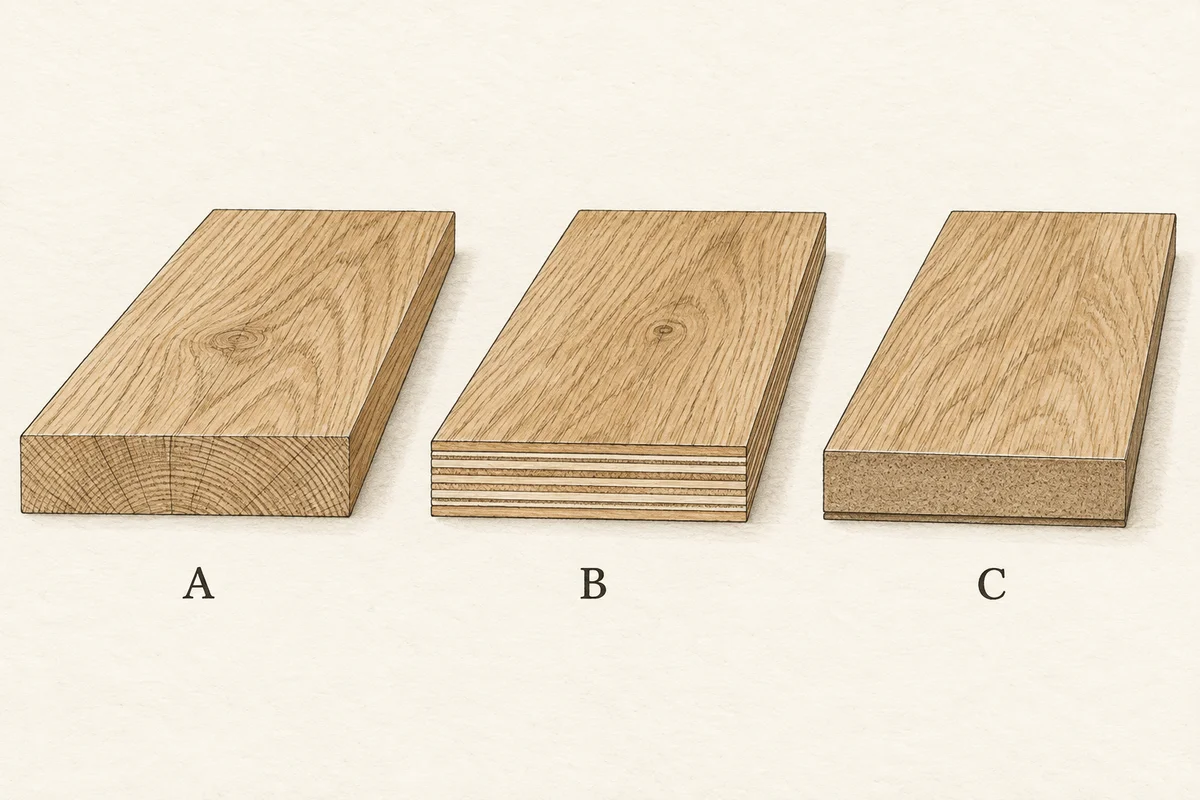
Illustration notes
AI-generated illustration. View larger image.
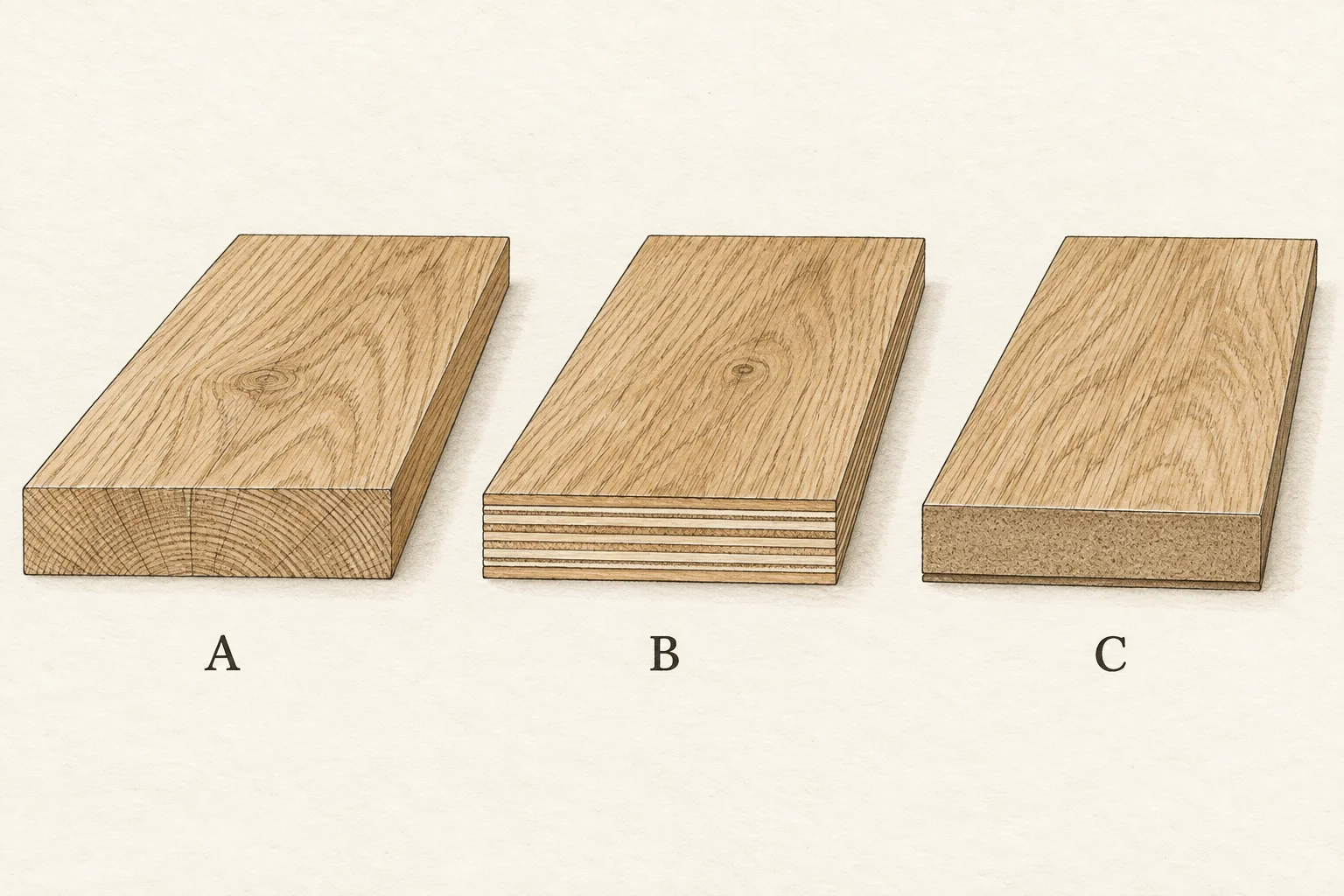
Solid timber is wood through the board's thickness. Junckers explains that its solid hardwood changes dimension with humidity; seasonal gaps can occur. Record room conditions and the pattern of change before assigning a cause. Different Junckers floor systems have their own fixing and preparation instructions. [FL01]
Engineered timber has a real wood face bonded to a supporting construction. Havwoods describes plywood and other layered arrangements. The visible wood layer is sometimes called the lamella. Its remaining thickness and the particular product matter when considering refinishing; “engineered” alone is not permission to sand. [FL02]
Laminate can carry a photographic wood or stone design beneath a protective surface. Quick-Step's described construction places those layers over high-density fibreboard, with a balancing backing. Do not confuse an oak image with an oak wearing layer. [FL03]
An HDF core alone is not conclusive: Quick-Step also describes real-wood products using wood or HDF cores. Read the face and core together and seek a product record. Where they cannot be established, “timber-effect boards; composition unconfirmed” is a useful description. [FL04]
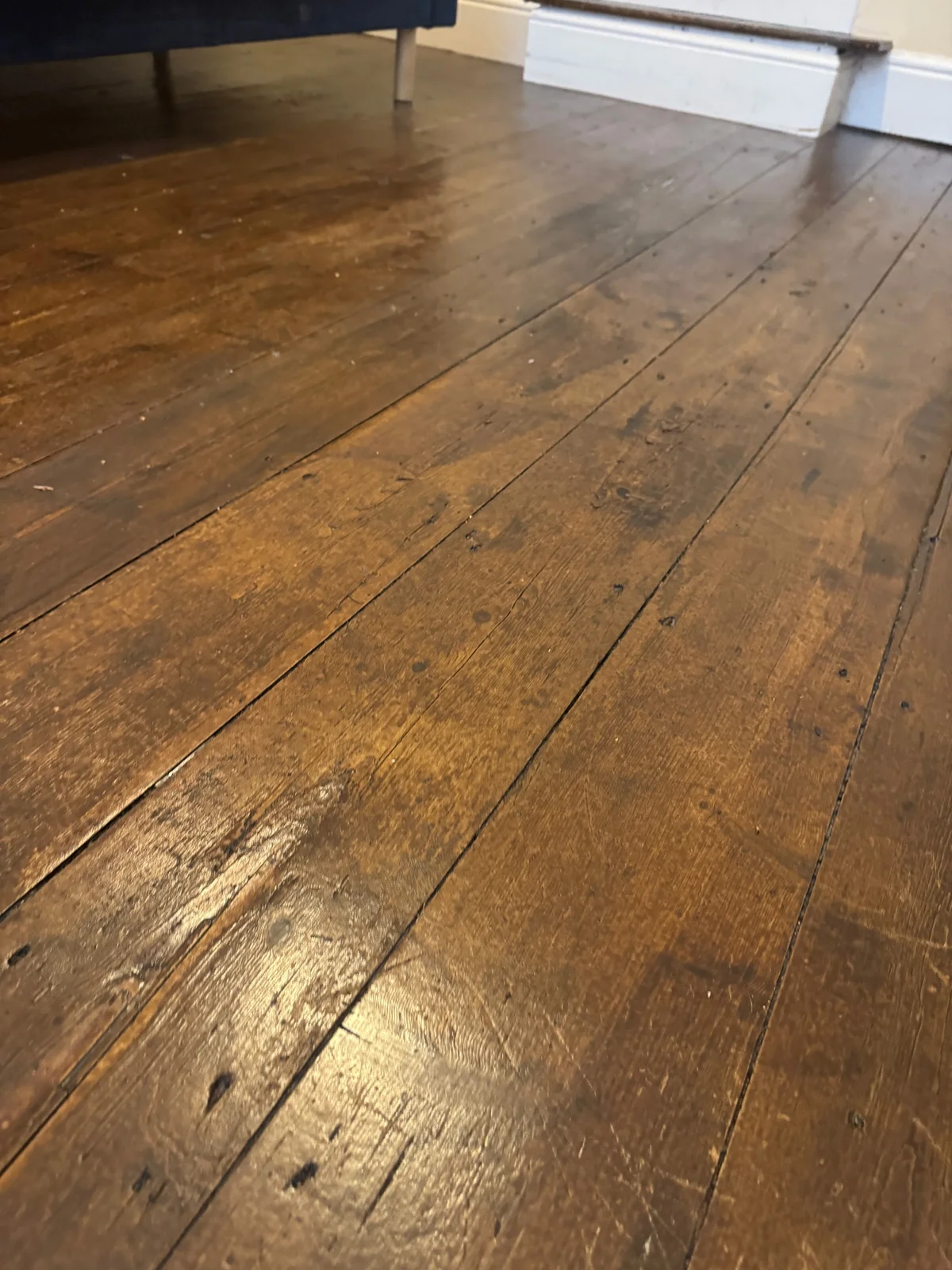
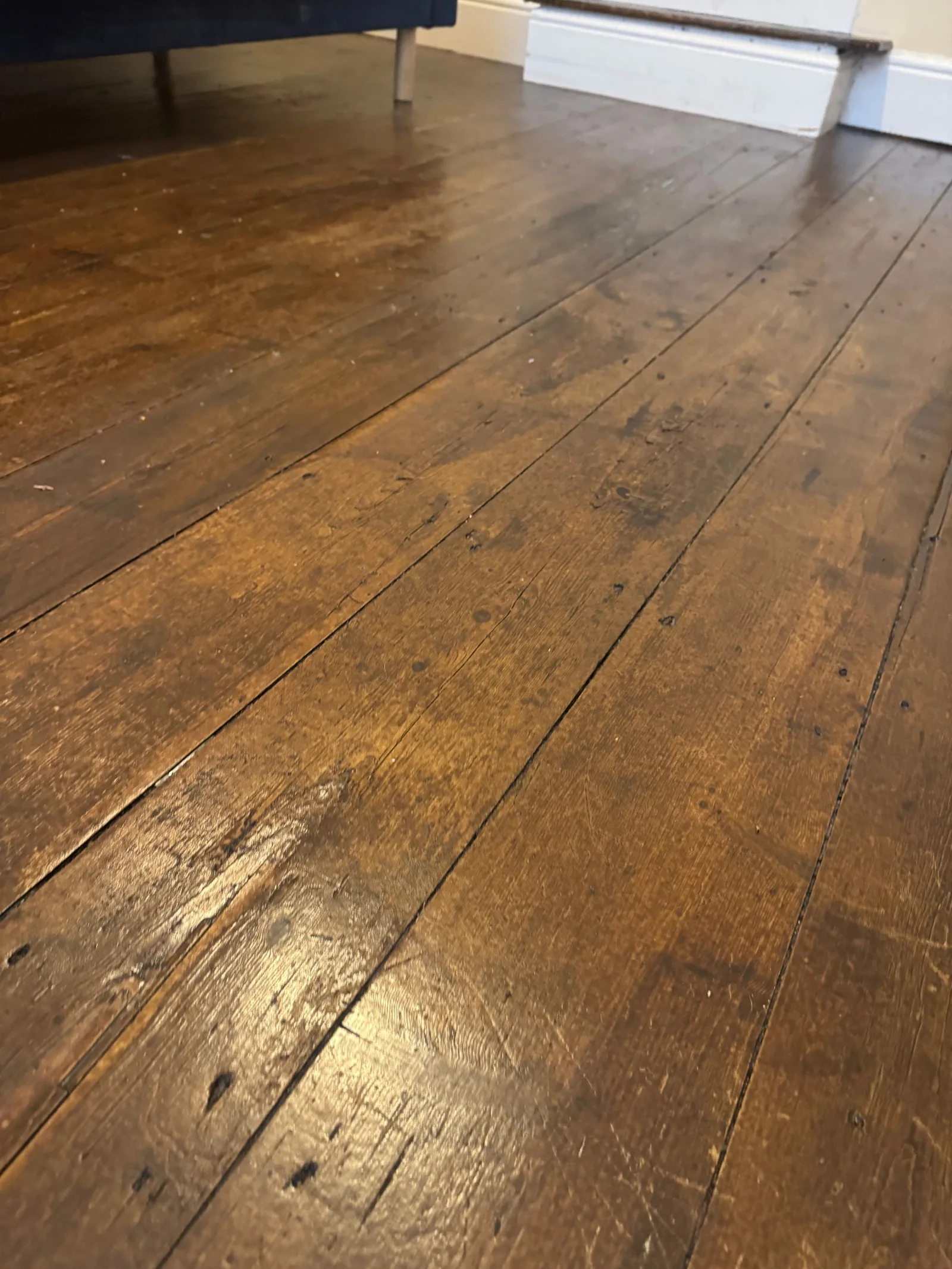
Joints, fixings, wear and local marks are visible in this board floor. The face helps describe its condition; it does not establish the timber species, full build-up or remaining sanding allowance.
Survey archive photograph · View larger image
Six more surface forms
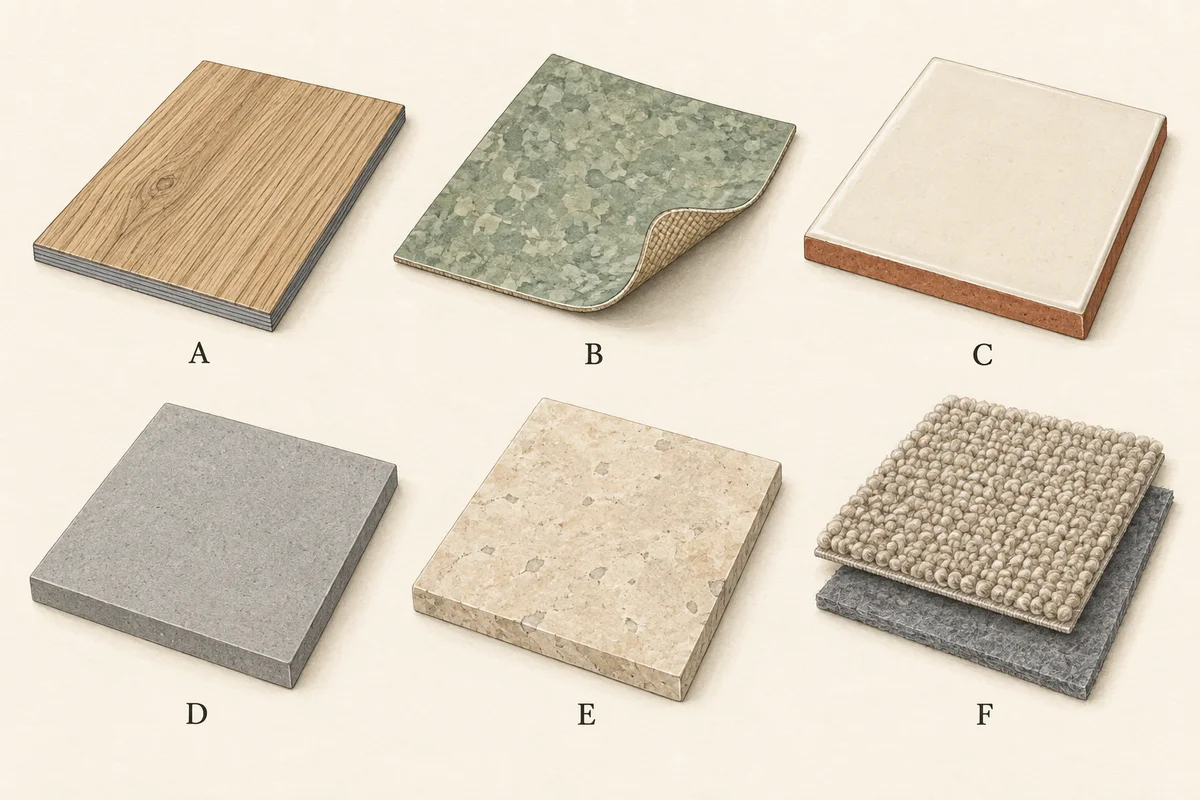
Illustration notes
AI-generated illustration. View larger image.
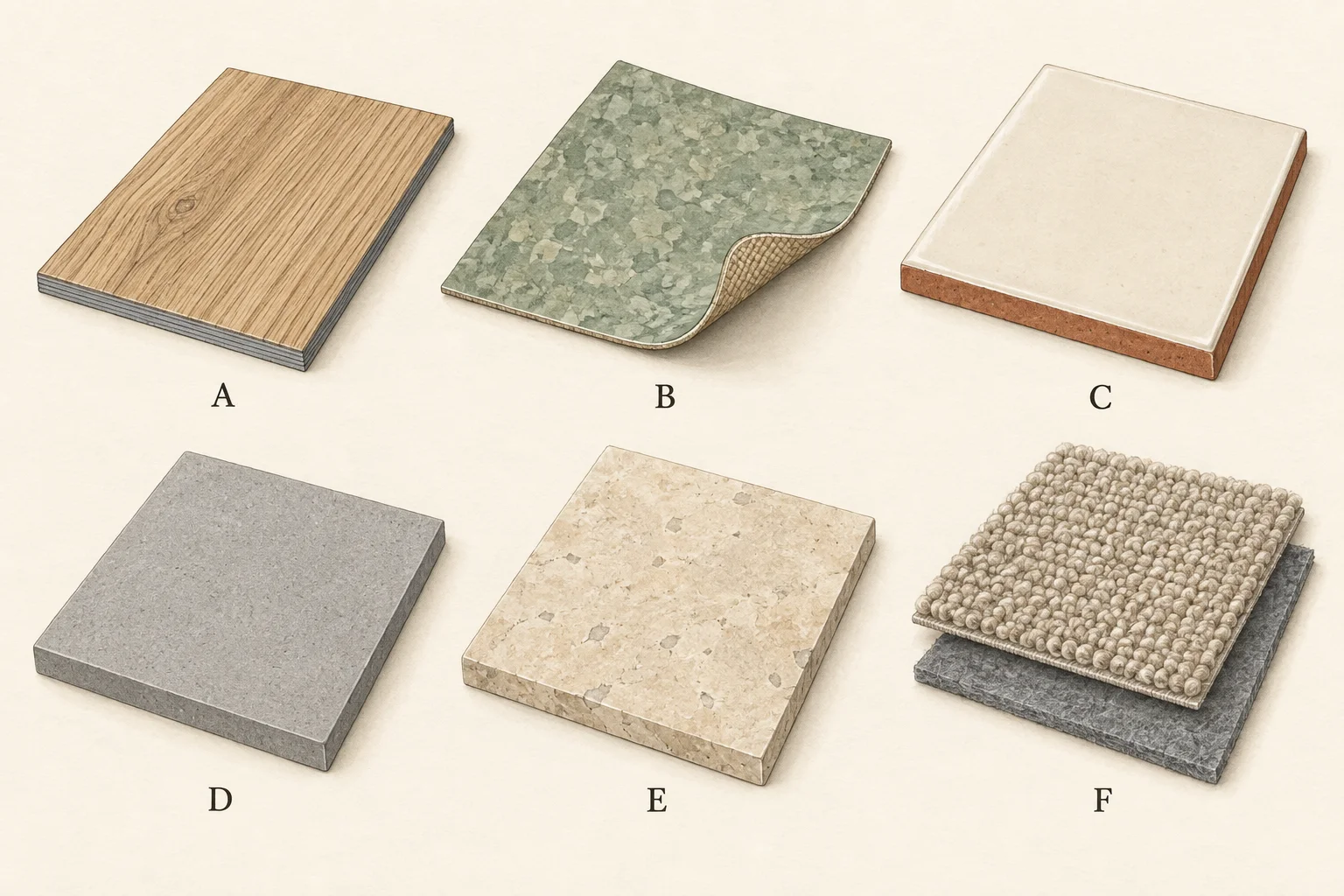
| Family | What the name does—and does not—tell you | Useful next evidence |
|---|---|---|
| Vinyl sheet, tiles and planks | A resilient covering family with different constructions and installation systems. LVT means luxury vinyl tile, also sold in plank formats. A timber pattern is decoration. | Exact range, format and installation guide; whether bonded, loose laid or a floating rigid-core system. [FL06–FL07] |
| Linoleum | A different material from vinyl. Forbo's Marmoleum uses ingredients including linseed oil, rosin, wood flour and limestone, with a jute backing in its described sheet construction. “Lino” is often used loosely, so verify it. | Product or sample identification; format and backing, rather than colour alone. [FL05] |
| Ceramic and porcelain tiles | Porcelain has very low water absorption and can be glazed or unglazed. Select the actual product for the proposed use. Surface gloss does not establish suitability for a wet floor. | Product identity, intended use, finish and relevant slip-performance information. [FL08] |
| Natural stone | Limestone, marble, granite, slate and sandstone are among the flooring stones; their properties vary. A stone-effect print is a different construction. | Stone and surface-finish identification, condition, compatible bedding and care requirements. [FL08] |
| Carpet and underlay | Pile, backing and any separate underlay are distinct parts. Cormar describes foam, rubber and felt underlays. The drawing shows one arrangement, not every carpet installation. | Carpet identity, backing, fitting system and the specified underlay. [FL09] |
Mosaic is a format, not one material: small units can be ceramic, stone or glass. Quarry tile and terracotta also deserve more precise descriptions than “red tiles”. The Tile Association's older introductory guide helps with these distinctions; it is not being used here as a current installation specification. [FL08]
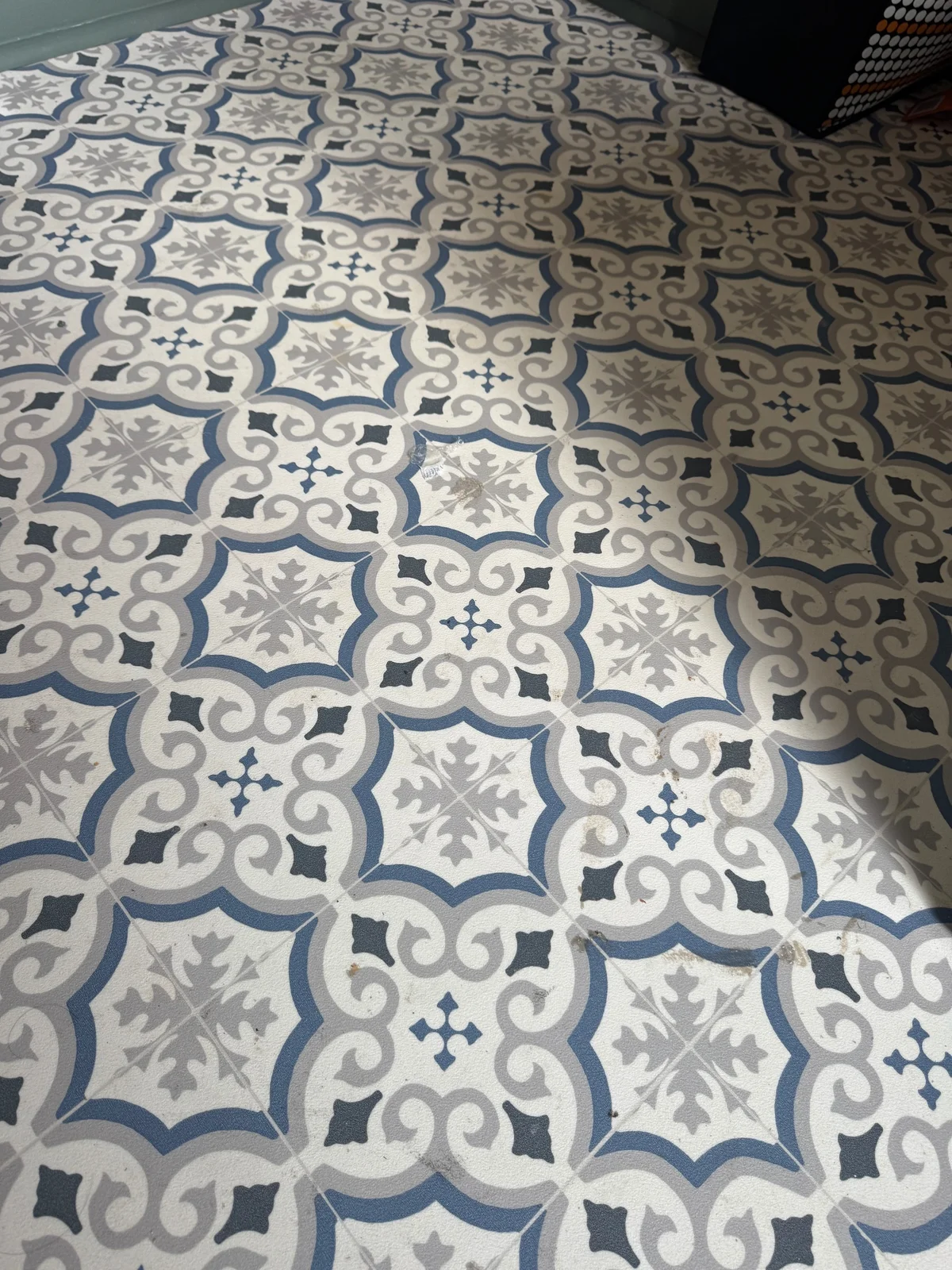
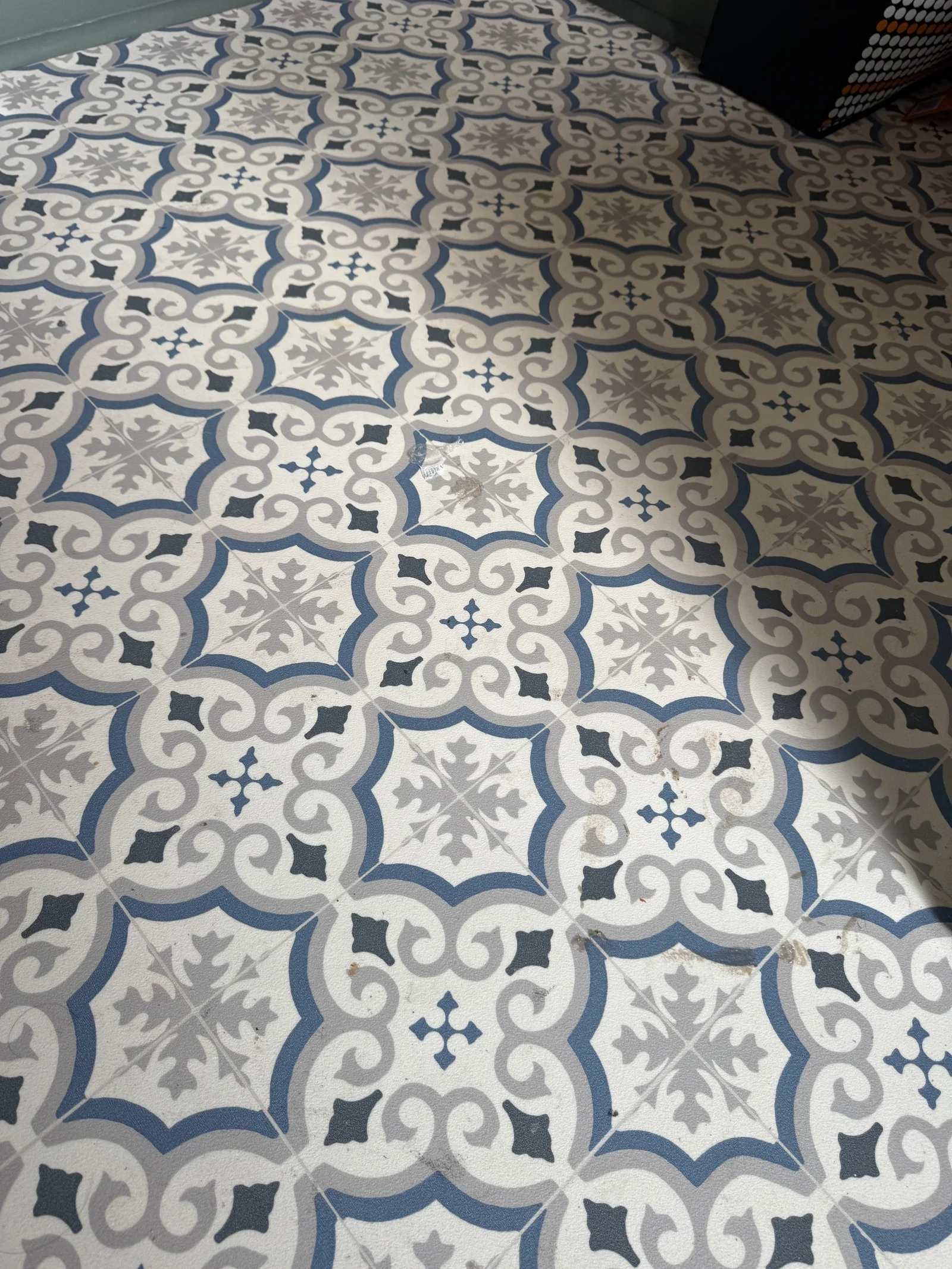
The geometric design resembles individual tiles, but a tile-like pattern is not proof of ceramic or cement construction. Record the visible pattern separately from the material identity.
Survey archive photograph · View larger image
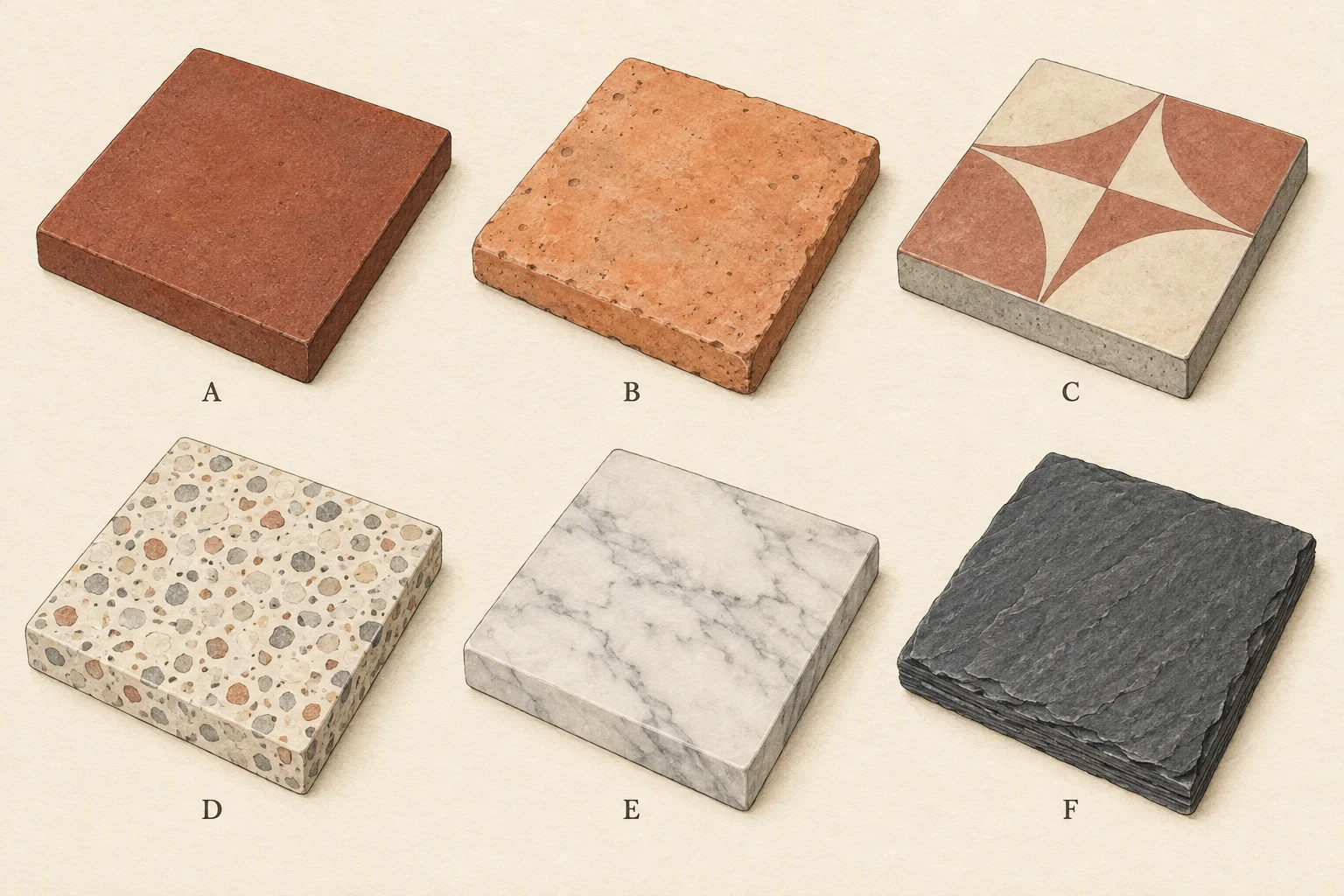
Fired clay, cement, terrazzo and stone
‘Red tile’, ‘marble effect’ and ‘Victorian pattern’ describe appearance. They do not establish the material. Compare the body and exposed edge with the face where an existing sample or safe exposure is available.
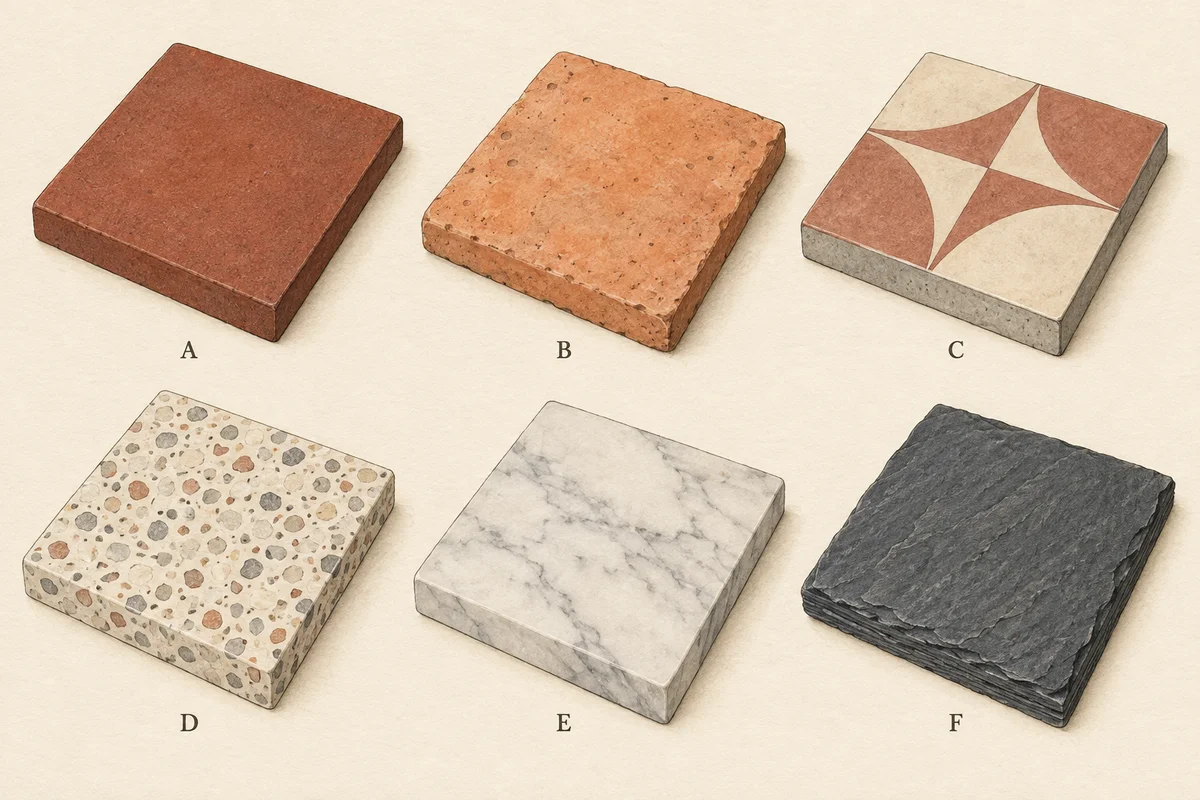
Illustration notes
AI-generated illustration. View larger image.
| Material or description | What makes it different | What matters when matching or caring for it |
|---|---|---|
| Quarry tile | An unglazed fired-clay tile, often with a plain red or brown face; it is not a piece quarried from natural stone. | Match size, thickness, surface and body, not just colour. [FL08] |
| Terracotta | Fired earthenware clay, often with a porous, varied surface. | Establish the particular finish and sealing/care requirements. Its warm colour is not proof of identity. [FL08, FL16] |
| Patterned cement tile | A cement-based manufactured tile, distinct from fired ceramic. Suppliers may market it as ‘encaustic cement’. | Establish the actual composition; a pattern name does not select a cleaning or installation system. [FL16] |
| Terrazzo | Aggregate pieces held in a matrix, creating a speckled surface; tiles and poured finishes are different formats. | Establish the binder and aggregate, surface finish and repair system. Terrazzo-effect porcelain is a different product. [FL16] |
| Marble | Natural stone, often with veining; the illustrated example has a honed face. | Identify the stone and finish before specifying cleaning, polishing or a replacement. [FL08] |
| Slate | Natural stone that can present a cleft surface and visible layering. | Compare texture, thickness and finish as well as colour. [FL08] |
Ceramic is a broad family, and porcelain is a ceramic type. Glazed/unglazed describes the face, while porcelain describes the tile body. A printed stone pattern can occur on porcelain without being natural stone. Mosaic describes small-unit format, not one material. A smooth surface also does not establish its slip performance in the proposed conditions. [FL08]
Herringbone and chevron are different layouts
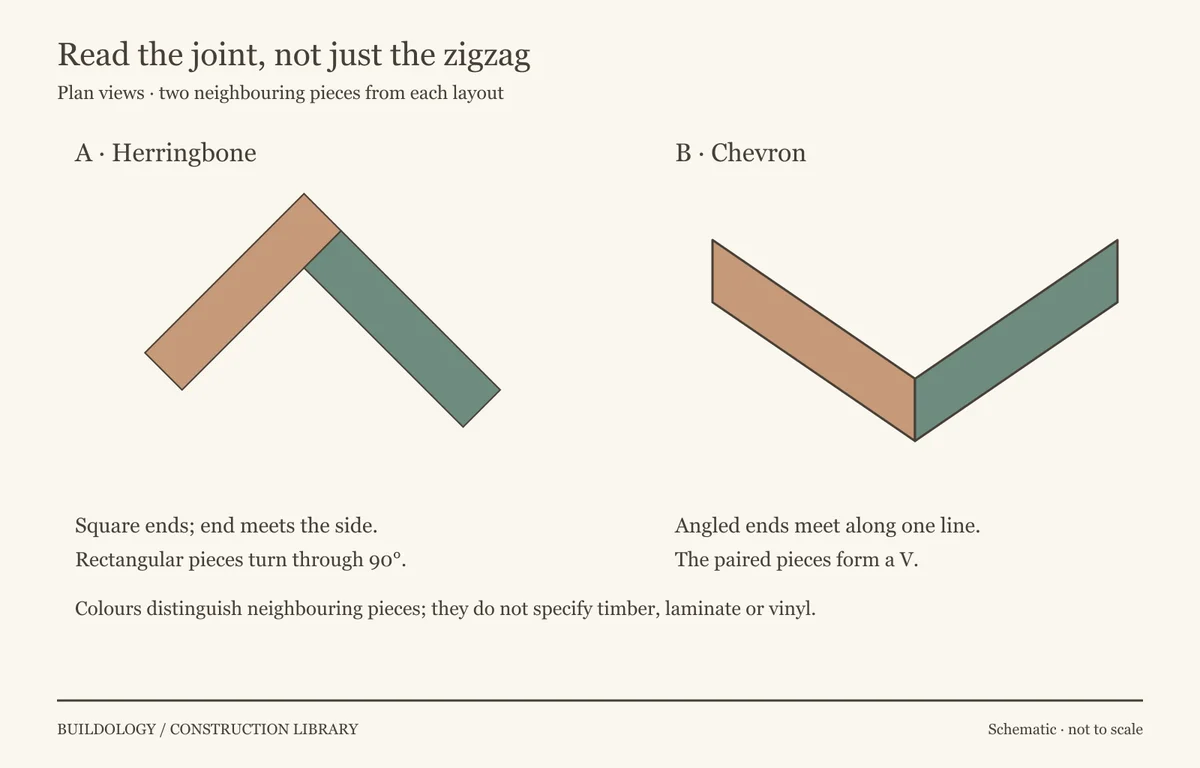
Illustration notes
Original explanatory diagram. View larger image.
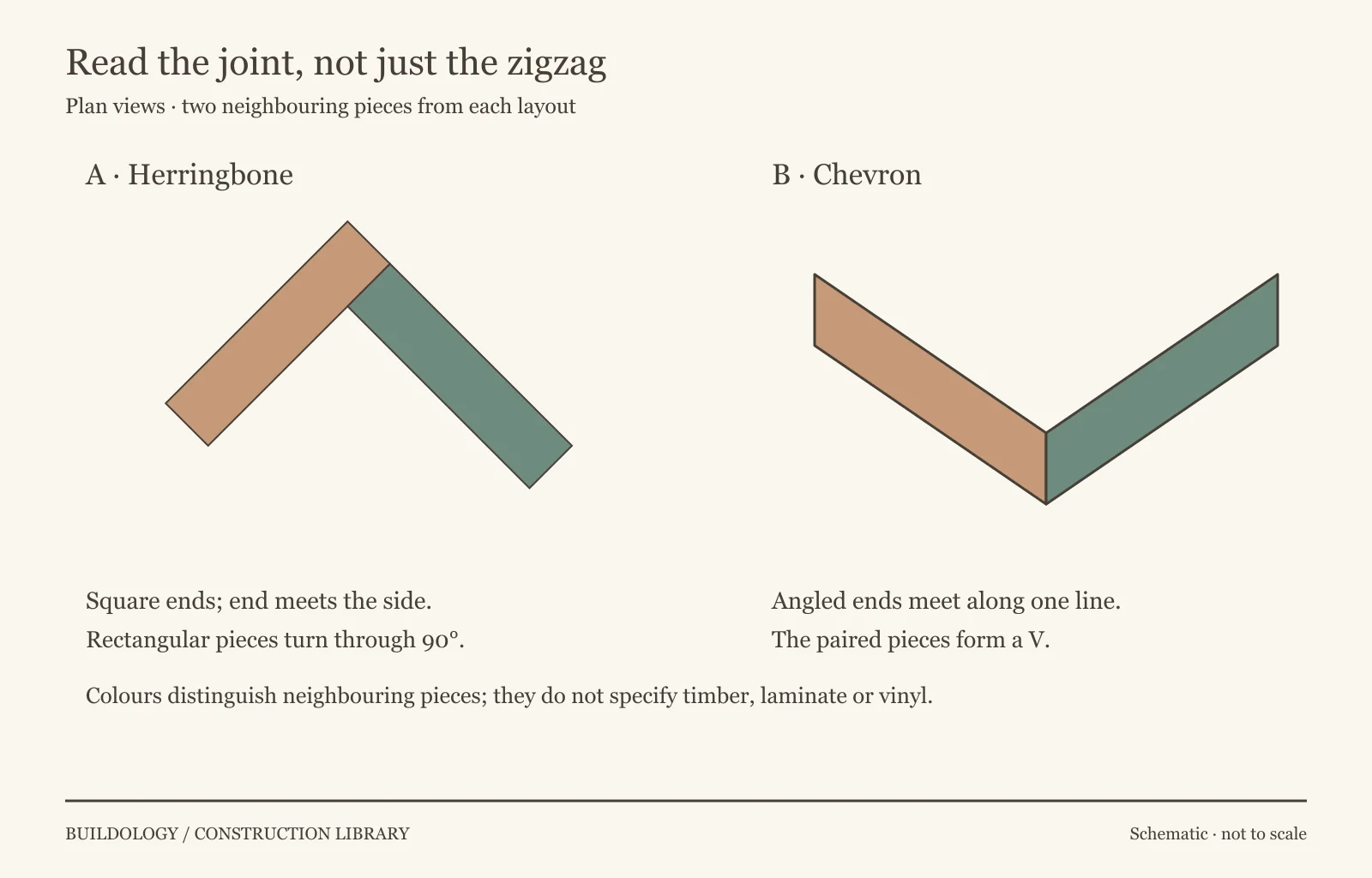
In a straight plank layout, boards run parallel and their end joints are arranged to the flooring system's requirements. In herringbone, the square end of one rectangular piece meets the side of another. In chevron, angled ends meet along a line. UK flooring ranges offer these as separate formats; the joint comparison explains the distinction. [FL15]
For tiles, a straight grid aligns joints in rows and columns; a brick-bond layout offsets rows. Selecting a pattern is a separate decision from confirming that the product and its installation guidance permit the proposed offset. Layout, material, dimensions and joint system all need to match when replacing a limited area.
Installation changes the repair question
Carpet: pile, fibre, backing and fitting
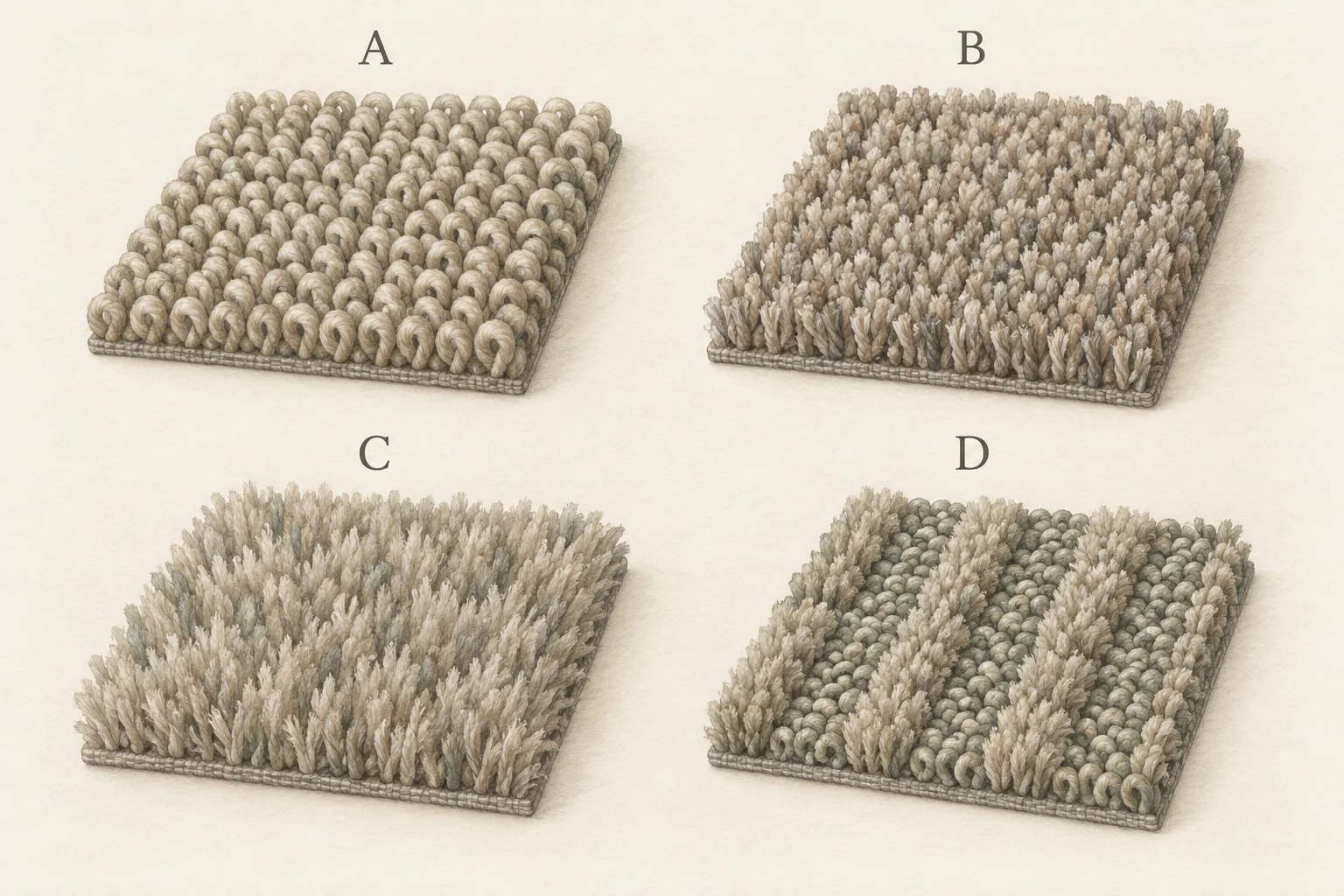
The pile is the yarn face you walk on. Its shape is different from its fibre: a loop can be wool or a synthetic yarn, while wool can be made into a cut pile. “Wool twist” combines a material and a surface description; it still leaves the backing and fitting system to establish. [FL17–FL18]
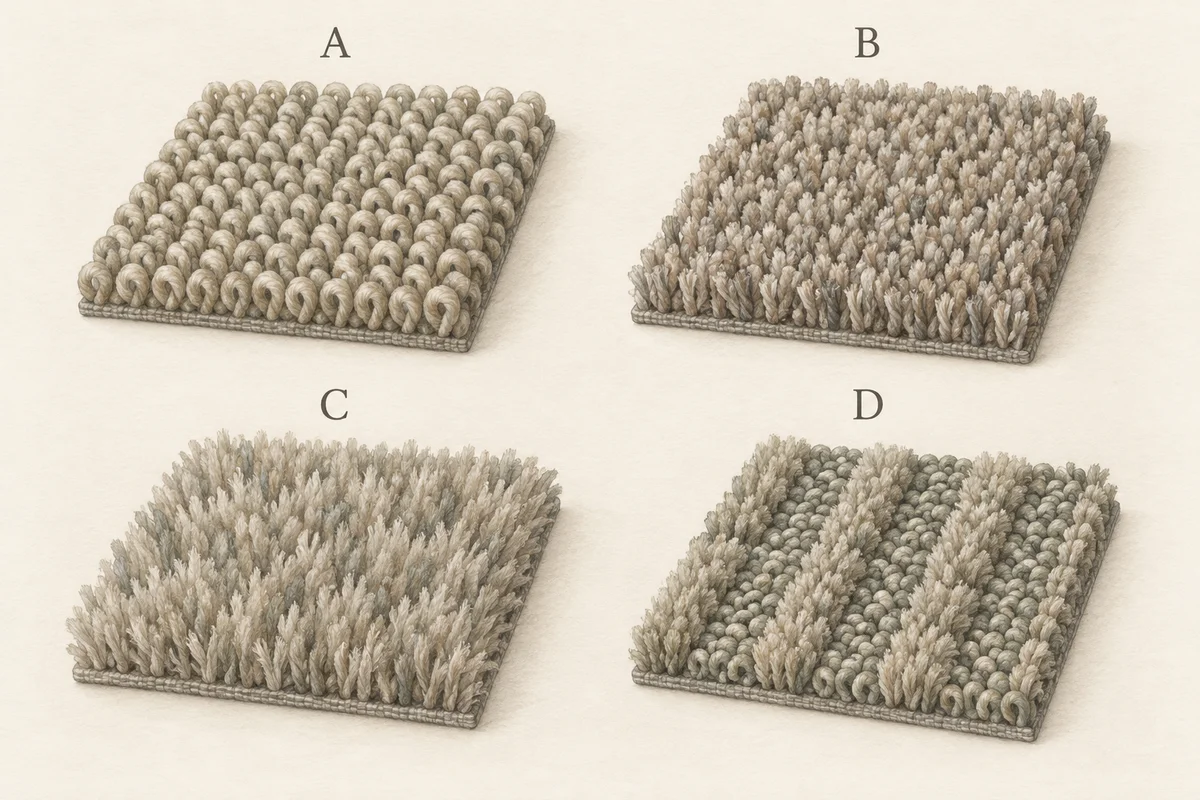
Illustration notes
AI-generated illustration. View larger image.
| Pile description | What you are looking at | Why the distinction helps |
|---|---|---|
| Level or textured loop | Uncut loops; differing heights can form texture. | A pulled loop differs from a worn cut tip. Check the product's use and care guidance. |
| Cut twist | Cut yarn ends with a twisted, textured appearance. | Match the yarn character and density as well as the colour. |
| Longer cut pile / Saxony | A deeper cut-pile face, commonly with a softer appearance. | The way the pile lies affects reflected light and the appearance of a join. |
| Velvet | A smoother cut-pile face using straighter yarn than a twist. | A similar colour in a coarse twist will not reproduce the surface. |
| Cut and loop | Both cut tufts and intact loops within one design. | Raised texture is part of the construction, not necessarily uneven wear. |
These are surface families, not a ranking. Berber is used inconsistently: Brintons describes a heathered, homespun appearance, and Cormar sells a Natural Berber Twist. Do not convert the word automatically into “loop pile”. [FL17–FL18]
Read the fibre separately. Wool, polypropylene and nylon (polyamide) are different fibres; blends combine them. Polyester also occurs in domestic ranges. A fibre percentage describes the yarn composition, not the entire carpet including its backing. A brand's cleaning claim applies to the identified range: “synthetic” does not make every carpet bleach-cleanable. [FL17, FL19]
Read the construction beneath the pile. In woven carpet, pile and backing yarns are incorporated in the weaving process; Axminster and Wilton are weaving families. Tufted carpet uses tufts carried by a primary backing, commonly stabilised with an adhesive and secondary backing. Neither “woven” nor “tufted” specifies the fibre or the fitting method. A secondary backing belongs to the carpet; separate underlay belongs to the installation. [FL17–FL18, FL20]
Stretch fitting over underlay and gripper differs from adhesive fixing. Confirm the carpet/backing and the specified method before judging a loose area or proposing refitting; do not assume every carpet needs the same underlay. At doorways and stairs, the combined thickness and edge detail matter as much as softness. [FL09, FL20]
A darker patch need not be a wet patch. Directional pile can reflect light differently. Compare the appearance from opposing directions and with the surrounding pile before describing it as a stain. This observation does not exclude a leak where other evidence suggests one; it explains why appearance needs context. [FL17; explanatory application]
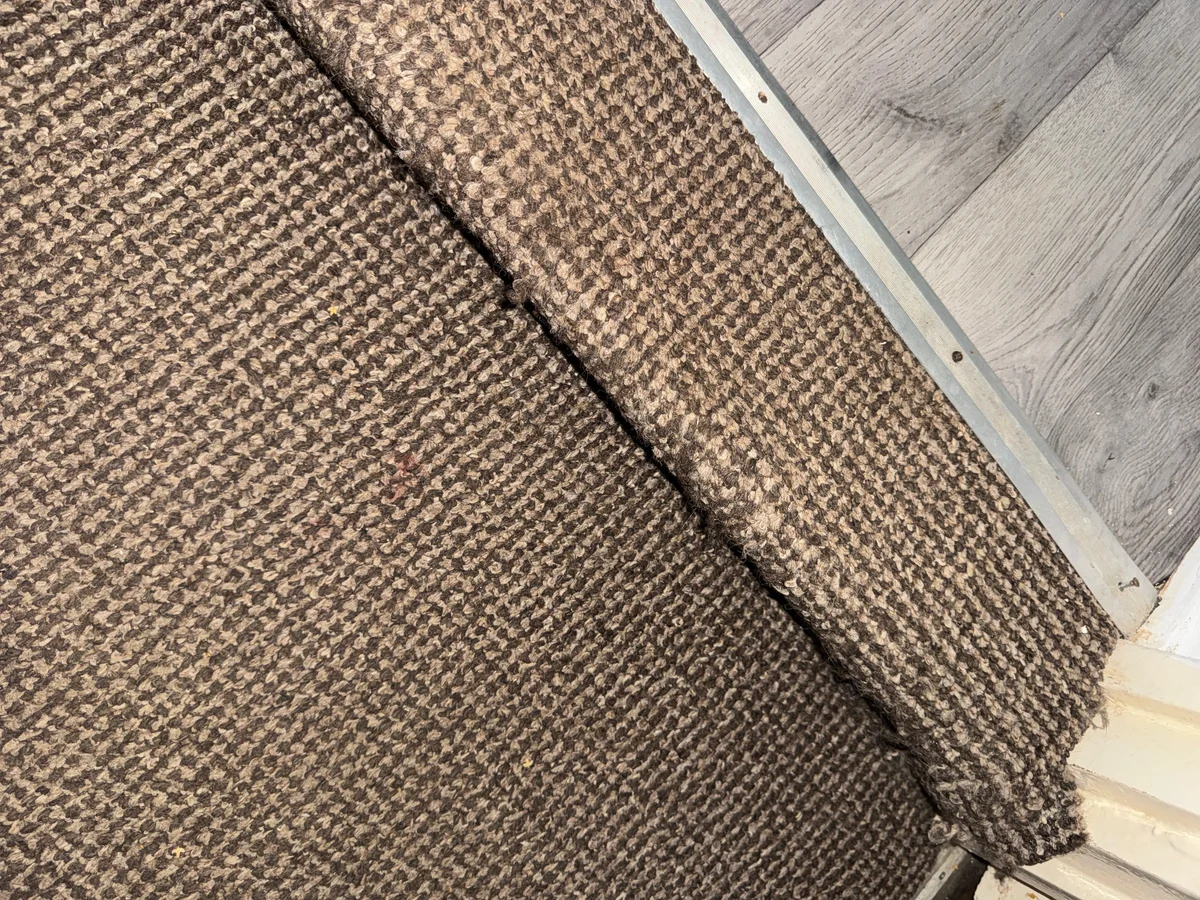
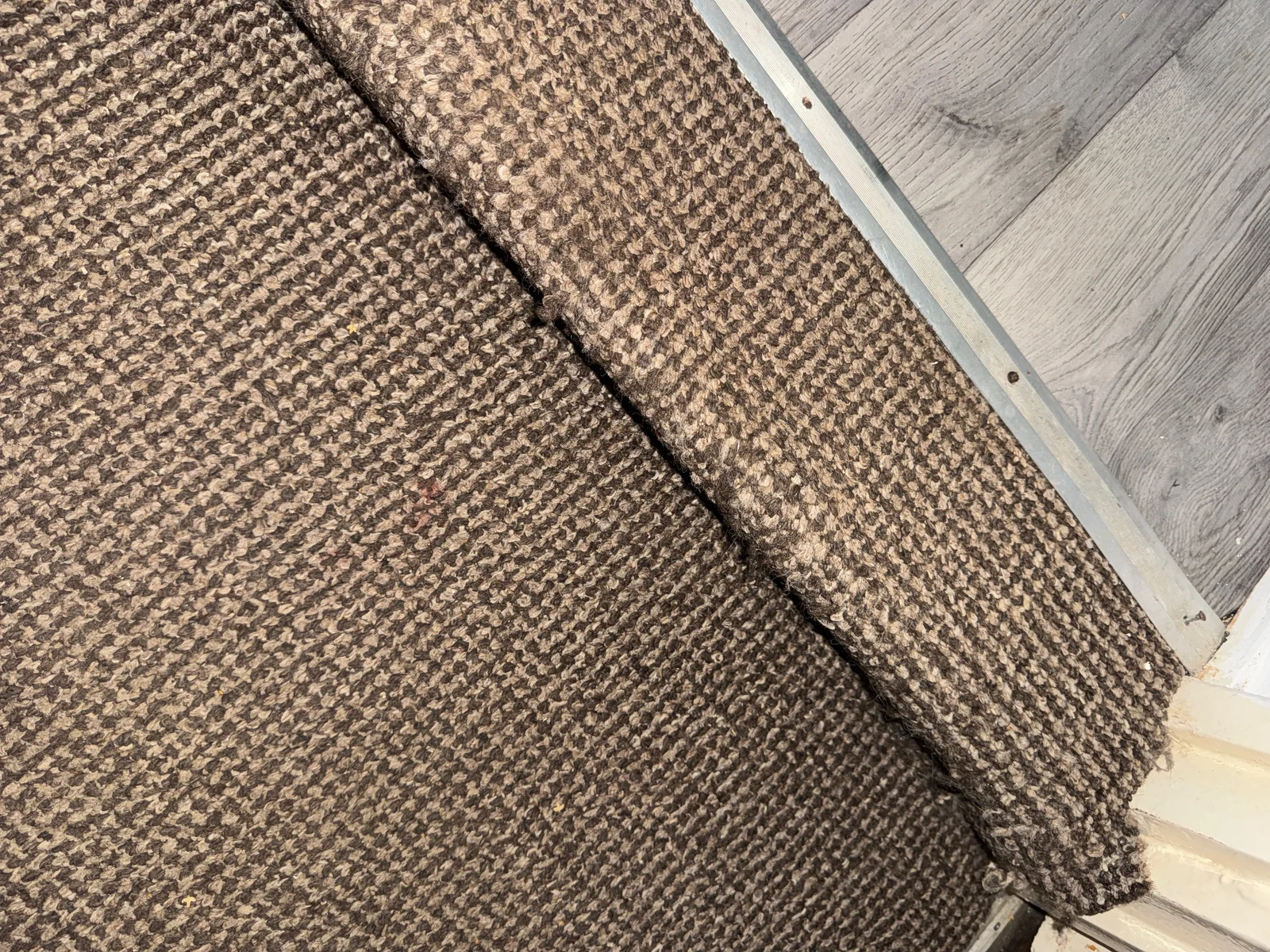
An open carpet join sits beside a metal threshold strip. The visible pile and edge condition are separate from the concealed fixing and supporting layers; the photograph does not establish why the join opened.
Survey archive photograph · View larger image
Resilient flooring: format is not the whole construction
A sheet, tile or plank is a format. Vinyl and linoleum are different materials, and a stone-pattern sheet may have no separate tile joints at all.
| Construction | What is different | What to compare |
|---|---|---|
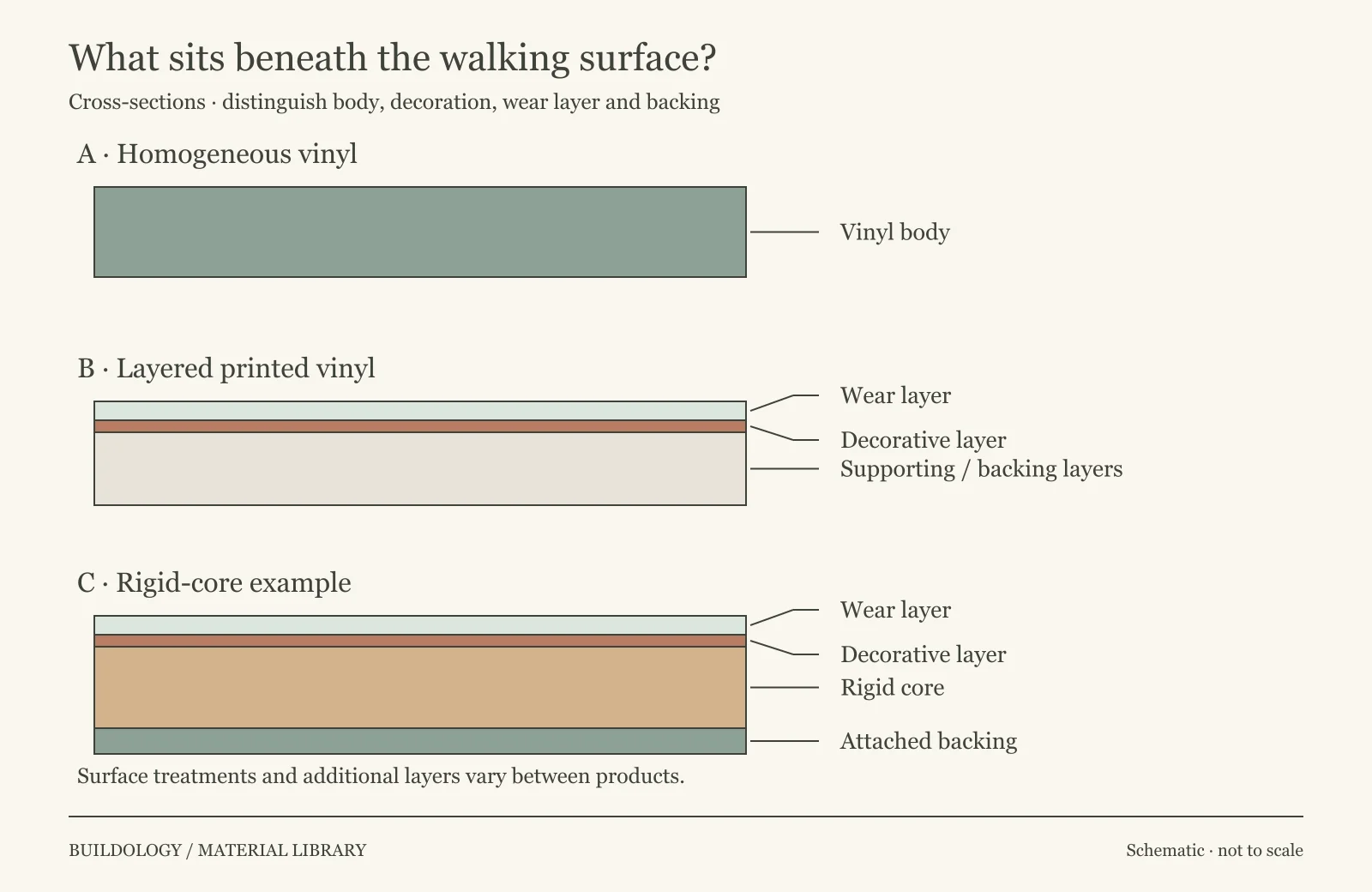
| Homogeneous vinyl | A broadly uniform body, rather than a separate printed decorative layer. A surface treatment may still be present. | Material, thickness, finish and product-specific maintenance. Polyflor's commercial sheet/tile range provides examples. [FL21] |
| Heterogeneous vinyl sheet | Several layers with different jobs; products can include a wear layer, decoration and a compact or cushioned backing. | Total thickness and wear-layer thickness separately; backing and indentation behaviour. Polyflor Secura is a residential sheet example. [FL22] |
| Flexible LVT | Individual vinyl tiles or planks; gluedown ranges need an appropriate prepared background. | Exact dimensions, edge detail, decoration, wear layer and adhesive system. [FL06, FL23] |
| Rigid-core click covering | A stiffer core with interlocking edges, commonly floated; an attached backing may be included. | Core/joint system, edge support and whether any extra underlay is permitted. [FL07] |
| Linoleum | A different material family; the illustrated sheet has a linoleum face on jute. | Exact format and backing. The term “lino” is not enough to select a repair adhesive. [FL05] |
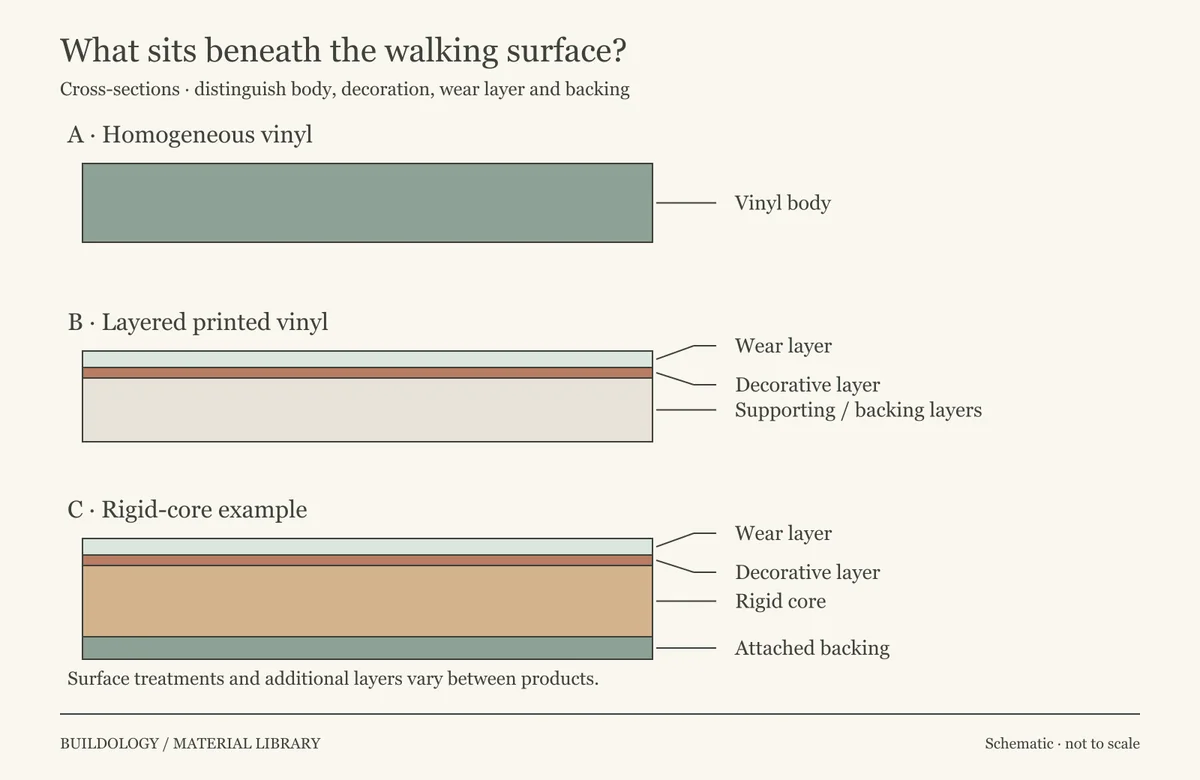
Illustration notes
Original explanatory diagram. View larger image.
Total thickness is not wear-layer thickness. Polyflor's March 2026 gluedown LVT sheet lists, for example, a 2.5 mm total gauge with a 0.55 mm wear layer. Those figures describe different parts of that variant. A thicker cushioned product is not automatically more resistant to surface wear, and a wear-layer figure alone does not establish slip resistance or suitability for the room. [FL23]
Follow the installation across the doorway
Karndean's UK gluedown instructions require an appropriately prepared, sound and dry background; its rigid-core instructions describe a floating installation. The rigid-core guide normally recommends lifting existing laminate and does not normally recommend a separate underlay. Those qualifications belong to that named system: they are not instructions for every vinyl product. [FL06–FL07]
For an existing floor, establish the fixing arrangement before assuming that a single damaged unit can be exchanged. Ask how access, joints, adjacent finishes and product availability affect the proposed repair. A matching colour name does not demonstrate matching dimensions, joint geometry or construction.
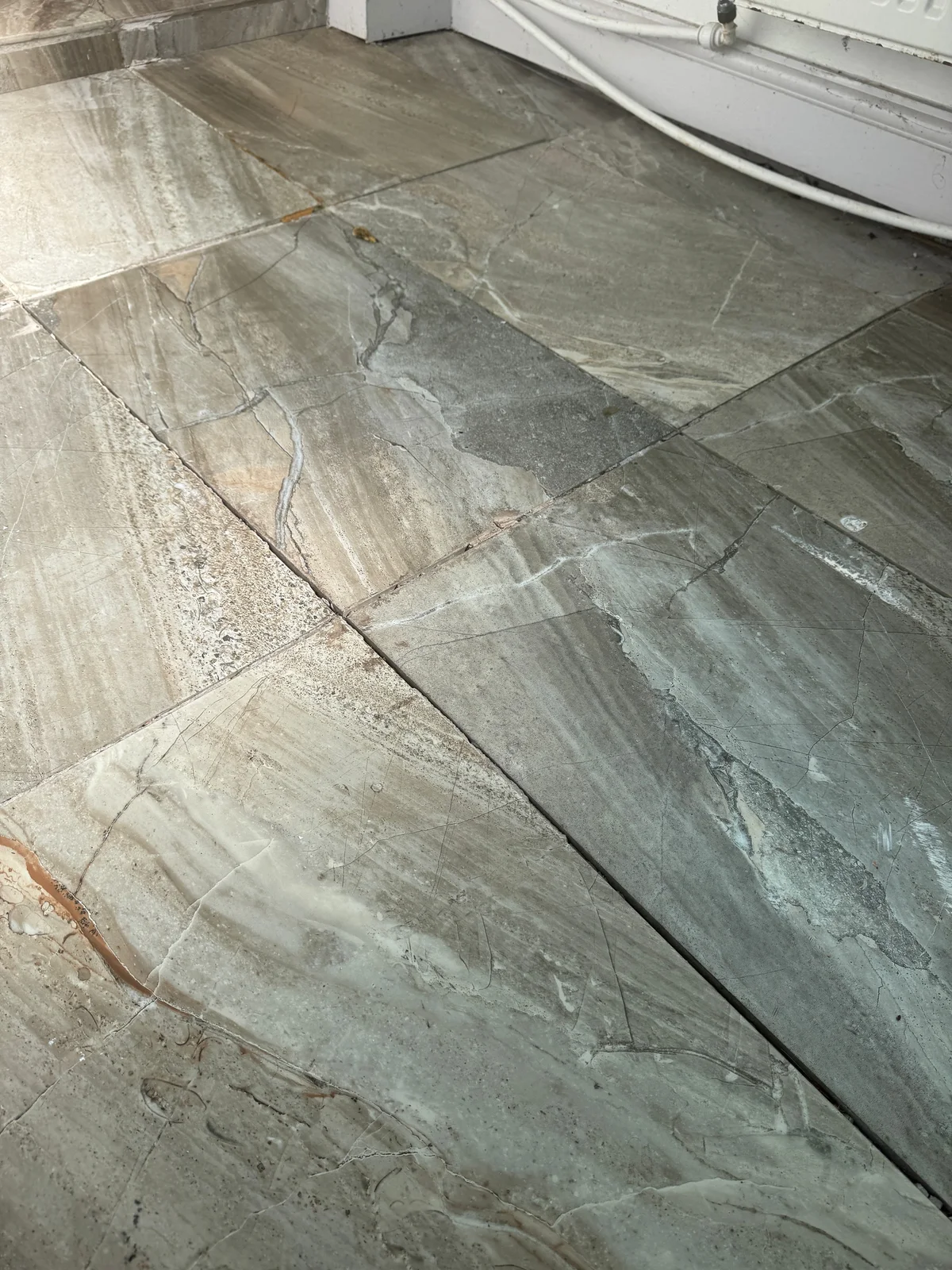
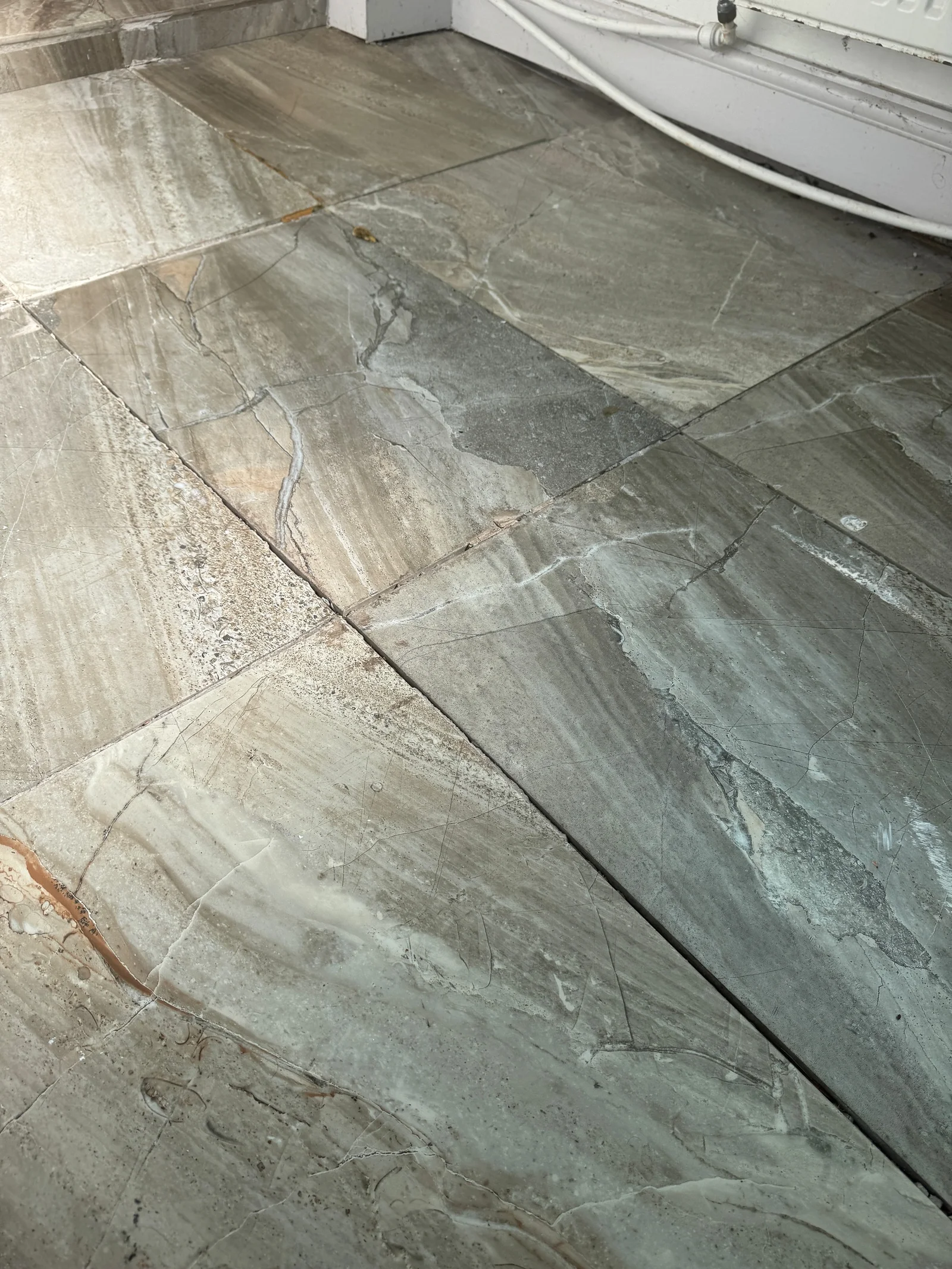
An open joint interrupts the tiled finish. Separate the visible joint condition from assumptions about the bedding or floor beneath; those layers are not exposed here.
Survey archive photograph · View larger image
Moisture, heating and sound
Moisture: distinguish a visible mark, an occupant's account and a measured result. A dry-looking face does not establish readiness for a new bonded covering. Karndean's gluedown guide specifies substrate testing and method-dependent limits. Record the substrate, test method, units, location and conditions; do not compare unrelated meter scales as if they measured the same thing. [FL06]
Underfloor heating: obtain compatibility information for the complete proposed floor. For carpet, Cormar notes that carpet and underlay contribute to combined thermal resistance, commonly expressed as a tog value. Do not select an underlay from softness alone. Check the limits for the exact heating and flooring system. [FL09]
Sound: England's Approved Document E describes separating-floor arrangements in which the base, ceiling, floor finish and junctions contribute to performance. A resilient surface can reduce impact sound at source. An “acoustic underlay” label alone does not demonstrate the performance of an existing floor between flats. Establish the building/work context and the actual assembly before assessing a change. [FL12]
Would a waterproof overlay resolve a previous leak?
Hypothetical example FL-01. Wood-effect flooring has raised short joints near a dishwasher. A hose leak was reportedly fixed six weeks ago. An unlinked offcut has an HDF core. The proposal is Karndean rigid-core flooring over the existing finish, with extra foam underlay, because ‘waterproof means no drying is needed’.
Work through the decision
The offcut has not been tied to the floor, and the floor's material and present moisture condition remain unresolved. A waterproof covering claim does not establish that the concealed background is dry, sound or suitable for an overlay.
Identify the exact range and apply its installation requirements. The named rigid-core guidance normally recommends lifting laminate and does not normally recommend a separate underlay; the proposal needs reconciliation with those instructions. Also consider the added level at doors, thresholds and stairs. [FL06–FL07]
Historic floors and concealed materials
SPAB advises retaining historic stone floors where possible. Introducing an impermeable layer can redirect moisture towards adjoining walls in some traditional arrangements. Treat a proposed overlay, membrane or heating installation as a change to the whole floor and its surroundings; investigate the existing moisture route and significance first. This conservation advice does not prohibit damp-proofing in all floors. [FL10]
Older floor tiles, sheet materials, backing and adhesives can contain asbestos; HSE notes that these can be concealed under later coverings. Neither a photograph nor black adhesive establishes presence or absence. Obtain appropriate asbestos information before work that could disturb suspect layers. [FL11]
Part L: identify what work is actually proposed
For work to a thermal floor in England, use the Approved Document L portal to establish the applicable requirements and whether the proposed work engages thermal-element provisions. Describe whether the proposal changes a covering, screed, insulation or the floor construction. The applicable requirements depend on the work to the floor, rather than the finish name alone. [FL13]
The 2026 Volume 1 introduction gives effective dates of 24 March 2027 for work not connected with higher-risk building work and 24 September 2027 for higher-risk building work, with separate transitional arrangements. Publication of that edition does not make it applicable to every current job. Wales, Scotland and Northern Ireland need their own regulatory routes. [FL14]
Check your understanding
A herringbone floor has an oak pattern and click joints. Which parts of its construction have you identified?
Reveal the distinction
You have described a layout, an appearance and a joint. You have not yet established whether the wearing surface is real wood, printed laminate or vinyl, or confirmed the concealed installation. Seek visible edge evidence and a product record linked to this floor; do not disturb unknown layers just to identify them.