A convincing stone pattern can sit on chipboard, resin-bound minerals or a fired slab. The top surface alone will not tell you which. Read a worktop through its face, core, edge, joints and supports: those distinctions explain how it can be cut, where water matters and what a sensible repair involves.
Start with the fitted kitchen if you need the cabinet vocabulary. This guide follows the surface above it, from ordinary postformed laminate to fabricated stone and metal.
Compare the material families
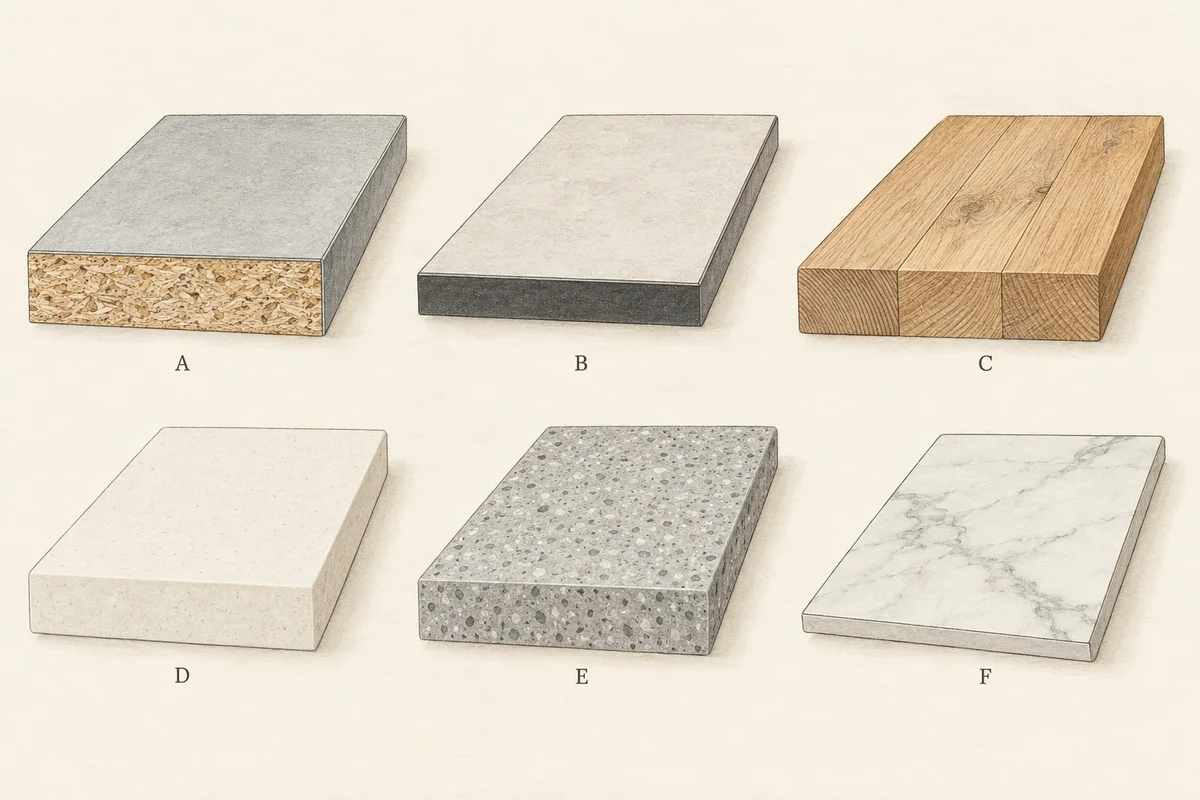
Illustration notes
AI-generated illustration. View larger image.
Laminate and compact laminate
Conventional laminate is a decorative wear surface bonded over a supporting board, commonly chipboard. A postformed front carries the laminate around a curved edge; a square-edged top has a separate edge treatment. Compact laminate is a dense laminate panel in its own right, with no chipboard core. It is often much thinner. EGGER's worktop range includes both constructions. WKT01
The difference matters beside a sink. Water reaching unprotected chipboard at a cut-out or joint can cause swelling. Compact laminate's moisture behaviour is different, but its junction still needs detailing to keep water out of the cabinet. Cut edges, holes and joints deserve separate attention from the intact face. WKT01
“Solid laminate” is a common name for compact laminate; it does not mean solid timber or solid surface. Check the product documentation and an existing exposed edge rather than making a fresh destructive opening just to identify the top.
Timber, solid surface and engineered mineral products
| Family | What it is | Useful distinction |
|---|---|---|
| Solid timber | Boards or smaller staves joined into a slab | The timber continues through the section; a wood-effect face on board is different. |
| Solid surface | A manufactured mineral/resin surface, such as Corian | Bonded components can produce a visually continuous top, bowl and upstand; “seamless appearance” does not mean no joints. |
| Engineered quartz or mineral composite | Mineral constituents combined with a resin binder | Composition varies by product and generation. “Quartz” is not a reliable universal silica percentage. |
| Porcelain or other sintered slab | A fired or sintered mineral-based slab | Read the actual manufacturing specification. These terms do not establish identical composition or performance. |
Timber moves with changing moisture conditions. Worktop Express's solid-wood instructions provide for movement at walls and fixings and require treatment of faces and cut ends. An oil finish is a maintenance system, not a permanent waterproof jacket. Their details apply to their products; do not transfer a gap or fixing schedule to every timber top. WKT02
Corian offers integrated bowls and coved upstands. Its care guidance also distinguishes finishes and warns against direct hot cookware; professional refinishing may restore an altered appearance. That possibility does not guarantee that every crack or scorch can be invisibly repaired. WKT03, WKT04
Caesarstone describes its quartz/mineral products as mineral and polymer mixtures, and its porcelain as a separately manufactured, fired product. Do not carry older composition claims over to a newer product bearing the same brand. WKT05
Natural stone and metal
Granite, marble, limestone, slate and quartzite are different stone families. Quartzite is natural stone, not the same thing as a resin-bound “quartz” worktop. Trade names can also differ from geological names. Obtain the stone's identity, finish and fabricator's care instructions before deciding on an abrasive, cleaner or sealer. The Stone Federation's 2016 code explains these distinctions; its historical installation details should not replace a current specification. WKT06
Veins and mineral variation can be original features. A sharp new discontinuity, a displaced edge or a crack crossing a joint needs a different assessment. A sample describes a small area; it does not promise that two slabs will share the same pattern. Stone selection should account for the actual use, surface finish and edge design. WKT07
Stainless steel may form a fabricated worktop with folded edges and integrated features. Superficial scratching can develop into an overall patina; dents, a lifted backing or a failed joint are different conditions. Cavendish's care guidance confirms that stainless steel can still mark and, in some environments, corrode. WKT08
Read the edge before estimating thickness
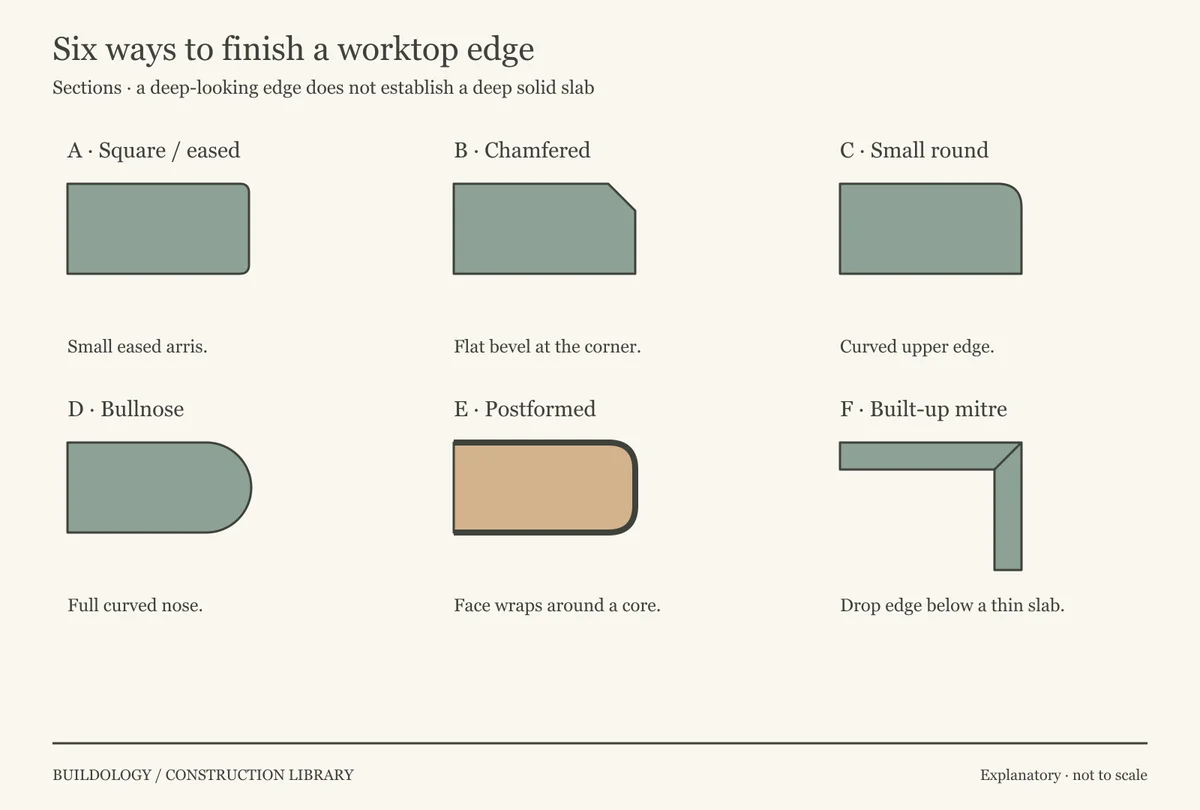
Illustration notes
Original explanatory diagram. View larger image.
A square edge usually has a small eased arris rather than a knife-sharp corner. A chamfer is a flat bevel; a pencil round is a small curve; a bullnose is a much fuller rounded profile. Decorative ogees have an S-shaped section. The material, thickness and fabrication method limit what is practical.
A built-up edge uses additional material below the front. A mitred drop can make a thin slab appear much thicker and carry a pattern around the corner. Look beneath it before describing the whole top as a solid slab of that apparent depth. The joint and any backing need identifying in their own right.
An upstand is the short vertical strip at the rear; a splashback protects a larger wall area. A waterfall end carries the surface vertically down the end of a unit or island. These are different components even when their decorative pattern continues.
Understand how the sink meets the top
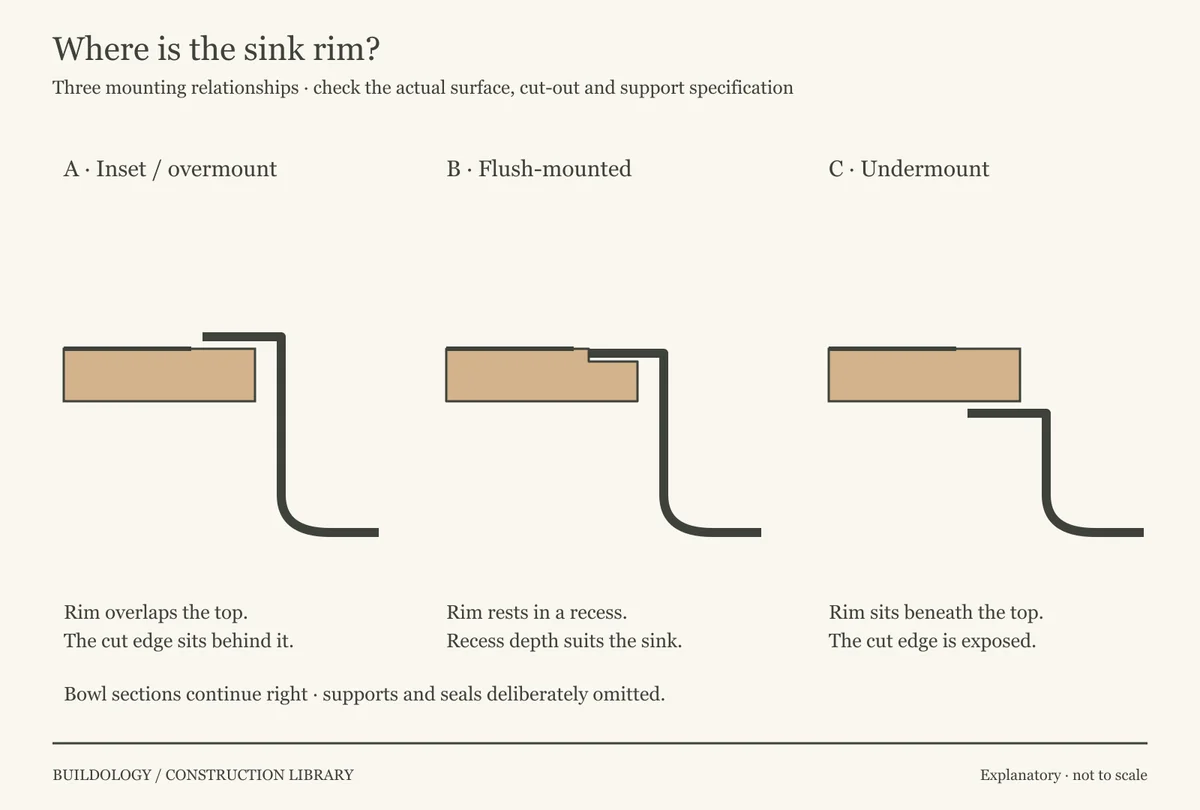
Illustration notes
Original explanatory diagram. View larger image.
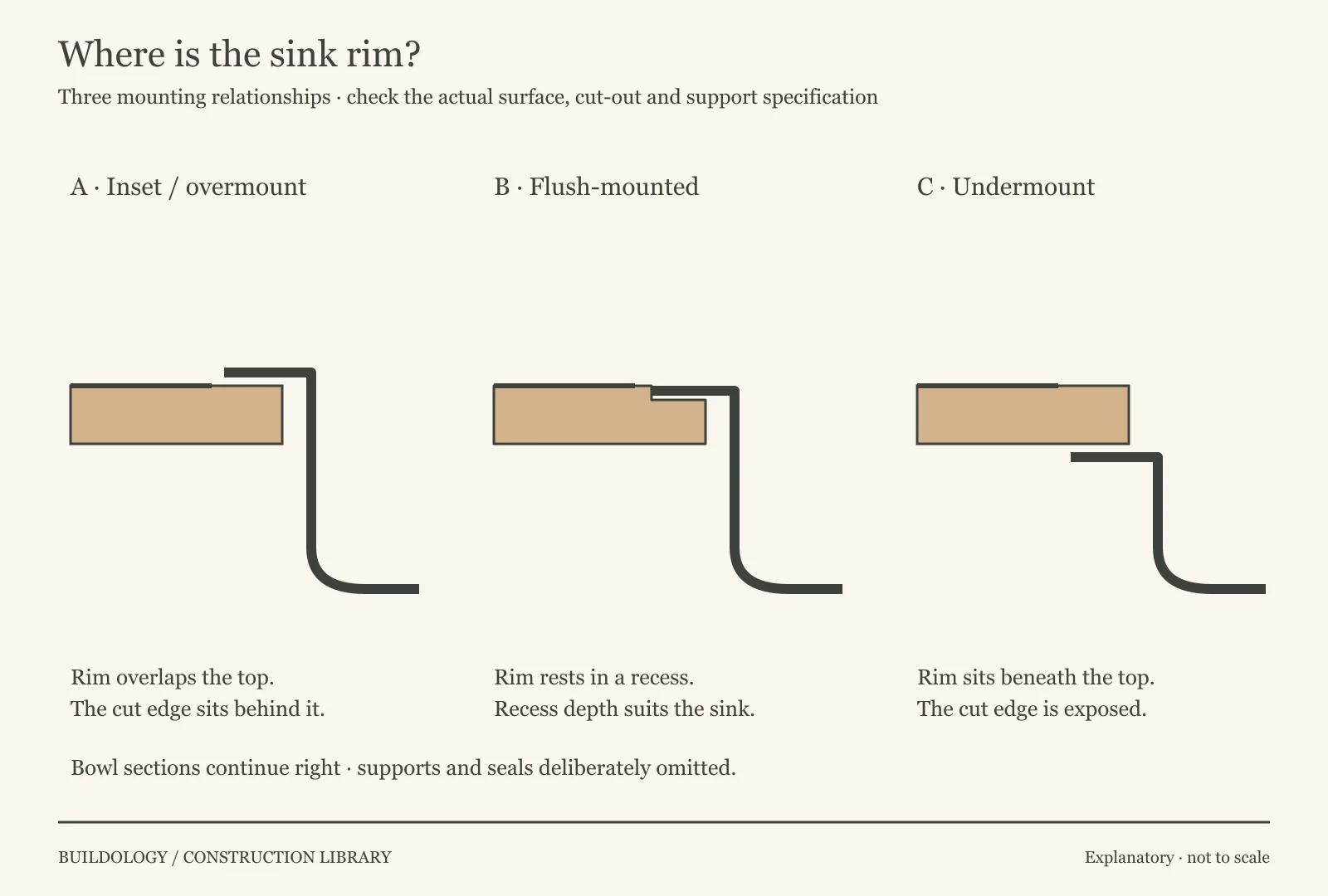
Inset / overmount: the rim overlaps the cut-out from above. Flush-mounted: the rim sits in a prepared recess with its upper face close to the worktop surface. Undermount: the bowl is below, leaving the cut edge visible. Franke uses these distinctions across its sink range. WKT09
An undermount sink needs a suitable exposed edge and an approved support/sealing arrangement. Do not reject every product called laminate: Worktop Express explicitly provides undermount details for its compact laminate. Conversely, cutting away an ordinary chipboard-core top's protective face does not make it suitable. WKT10
A replacement sink with the same overall width may have a different cut-out, corner radius, bowl depth or fixing position. Its waste and any disposal unit must also fit within the cabinet. Compare templates and the underside, not just the visible rim. EGGER's current instructions separately address cut-outs, thin tops and cabinet conflicts. WKT01
Joints, supports and the final template
A straight seam joins two pieces along a run. A mason's mitre is the short curved/routed corner junction familiar on many laminate tops; a full diagonal mitre is a different arrangement. A stone seam, a solid-surface bonded joint and a timber worktop connection are not interchangeable specifications.
The sensible sequence is to settle the cabinet positions, levels, support panels and exact appliances before templating a fabricated top. Howdens' preparation instructions also identify situations needing sink support before measurement. Moving a unit afterwards can invalidate the template. WKT11
Overhangs and spans need the surface supplier's design. A thick-looking front does not prove a cantilever is adequate. Around a sink or hob, the remaining narrow strips are particularly vulnerable during handling. Do not use a photograph of another island as a support detail.
For a thin replacement, check the whole vertical stack: hob body, ventilation space, drawer top, sink clips and the cabinet rail. A top that fits the plan can still conflict beneath it. Reuse is possible only if those interfaces remain compatible.
Distinguish marks from construction failures
| Finding | What it may mean | What changes the response |
|---|---|---|
| Raised laminate at a joint | Core swelling, face separation or a disturbed seam | Identify the affected layer and water route; pressing the face down does not restore a swollen core. |
| Timber darkening near a sink | Surface staining or more persistent wetting | Examine the finish and accessible edge; colour alone does not establish decay. |
| Dull patch on stone | Surface alteration, wear or residue | Identify the stone and previous treatment before choosing a chemical or abrasive. |
| Crack from a cut-out | Local damage or stress concentration, potentially involving support or heat | Trace the crack and inspect the surrounding construction; the pattern alone does not establish causation. |
| Open rear junction | Movement or seal failure | Resolve the moving or unsupported component before simply resealing. |
A repair needs both a compatible method and a realistic visual result. Pattern, gloss, edge continuity and the amount that can be retained matter alongside physical soundness. Replacement extent follows the findings and access constraints; it is not automatically the whole kitchen.
Plan fabrication safely
Cutting, drilling or grinding stone can release respirable crystalline silica. HSE advises completing as much fabrication as possible in an equipped workplace, controlling unavoidable site work, using suitable extraction or water suppression and appropriate respiratory protection, and preventing dust spread during cleaning. Dry sweeping is unsuitable. This is a fabrication hazard; an intact finished slab is a different exposure situation. WKT12
Material marketing is not a dust-risk assessment. Confirm the exact product and proposed task with the fabricator. Do not recommend on-site dry cutting as a quick way to enlarge a replacement hob opening.
Can the new sink use the old opening?
Hypothetical example WKT-01. An inset sink is to be replaced by an undermount bowl. The worktop has a stone-effect face, but the existing cut-out reveals swollen chipboard. The proposed bowl is smaller than the old rim.
Work through the compatibility question
Identify the construction. The core establishes a laminate-faced board; the stone pattern does not establish stone. Swelling also means the existing edge is no longer a sound, unchanged substrate.
Compare the actual openings. A smaller bowl may expose part of the original cut-out. An undermount arrangement adds an exposed edge and different support requirements.
Choose a viable assembly. Investigate the water route, then compare a compatible inset replacement with a properly specified replacement top and undermount system. Do not approve conversion by applying sealant to the damaged core. Compact laminate would be a different product assessment. WKT10.