Two walls can share a colour while having very different finishes. Sheen changes the light you see; the coating system governs how the paint bonds and wears. Wallpaper adds another set of choices: face, backing, texture, pattern and adhesive.
Use this guide to recognise common finishes in British interiors, read a product description and understand what a successful match or repair needs. For plaster itself and failures between deeper layers, start with plaster and decorative finishes.
Read the finish in four parts
Background → preparation → coating or covering → visible surface. Each part affects the result. A brilliant topcoat cannot hold a loose background together, and a perfect colour match may still stand out if its sheen or texture differs.
For paint, separate colour, sheen, formulation and intended substrate. For wallcoverings, separate the decorative face from its backing and hanging method. The following comparisons make those descriptions more precise.
Paint sheen: what happens to the light?
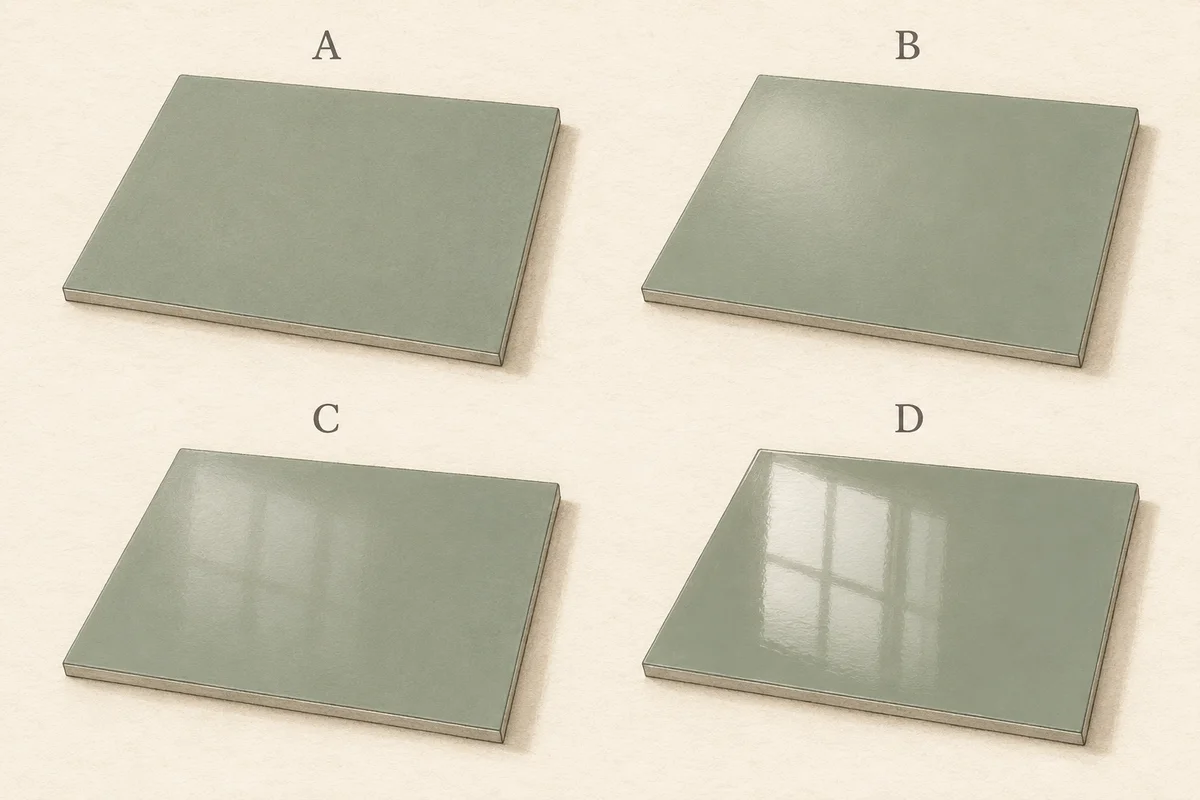
Illustration notes
AI-generated illustration. View larger image.
| Description | What it tells you | What it leaves open |
|---|---|---|
| Flat / matt | Little visible sheen; light is scattered rather than clearly reflected. | Cleaning performance and moisture suitability depend on the formulation. |
| Eggshell | A low-sheen family, named for its subtle lustre. | It may be intended for walls, woodwork or both; read the product scope. |
| Satin / silk / soft sheen | A more apparent sheen in many ranges; terms are not interchangeable specifications. | The intended substrate, sheen measurement and cleaning requirements. |
| Gloss | A strongly reflective finish that makes reflected shapes more apparent. | It can be water-based or solvent-based; shine does not identify the binder. |
Little Greene's product data sheets distinguish Absolute Matt Emulsion, Intelligent Eggshell, Intelligent Satin and Intelligent Gloss as separate products with separate preparation and performance information. Use them as examples of why a finish name is only the beginning of a specification. D01–D04
Sheen is not a durability scale. A matt coating can be formulated for cleaning. Compare the actual wet-scrub classification and care instructions where those properties matter, rather than assuming that every glossy paint is tougher than every matt paint. Cleaning abrasion, stain removal and resistance to prolonged wetting are also different questions. D01–D04
Colour matching needs the final finish
A colour name or code is useful, but the completed appearance also depends on sheen, texture, lighting and the surrounding surface. Assess a dried sample of the intended product in the room. A sample supplied only in matt cannot demonstrate how the same colour will look in gloss.
For a local repair, agree the natural stopping points and view the trial from normal positions in daylight and artificial light. A small patch can be technically sound yet remain visible. This is a matching decision to resolve before agreeing the extent of redecoration.
Primer, undercoat and topcoat have different jobs
A primer prepares a particular substrate for adhesion or addresses a specific issue. An undercoat provides a suitable intermediate base for the finishing coat, including colour coverage. The topcoat provides the exposed decorative finish. Some products combine roles or are self-priming on specified backgrounds. D05
This is why “one primer everywhere” is an incomplete instruction. Bare plaster, previously painted timber and exposed metal present different surfaces. A stain-blocking product is selected for a particular stain and coating system; it does not repair the source of wetting.
New plaster and the mist coat
A mist coat usually means a suitably thinned initial coat used on absorbent bare plaster. It is not a universal recipe. Little Greene's Absolute Matt guidance requires new plaster to dry and gives its own thinning instructions for a primer coat. Other systems use a designated primer/sealer. Follow the exact product's current data sheet and background requirements; a remembered water-to-paint ratio is not a specification. D01, D05
Setting, drying, recoating and full curing describe different stages. A surface that feels firm may still contain moisture, and a recoat time is not necessarily the time at which a paint can tolerate cleaning. Plan the sequence around the actual materials and conditions. D01–D03
For historic limewash, soft distemper or significant surviving decoration, use the plaster and finish guide. A modern coating should not be chosen solely because the existing face looks matt.
Wallcoverings: the face and backing are separate
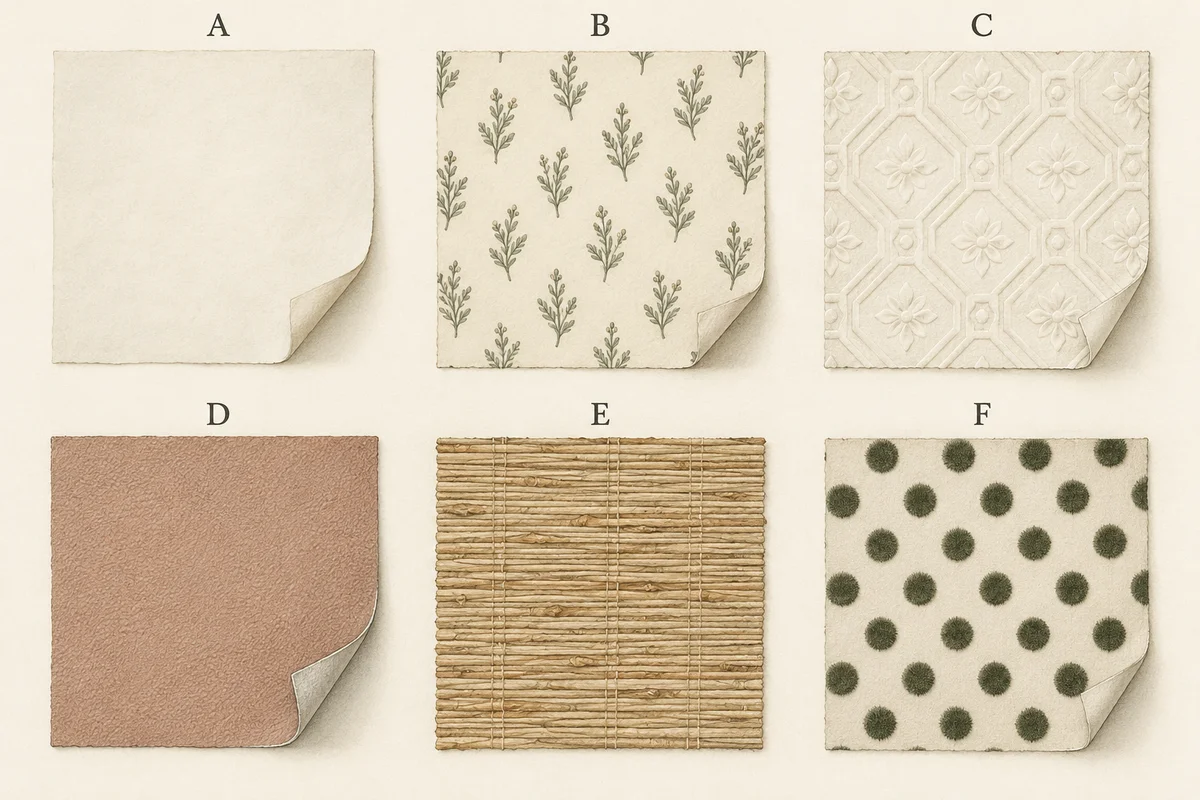
Illustration notes
AI-generated illustration; decorative patterns are generic. View larger image.
| Family | Useful distinction | What matters for a match or replacement |
|---|---|---|
| Lining paper | A plain base beneath paint or decorative paper. Conventional pulp papers come in different grades. | Grade, sound background, adhesive and drying before the next finish. It cannot repair unstable plaster. D07 |
| Printed paper | A flat printed design, with paper or another backing depending on the product. | Design, colourway, roll/batch, repeat and hanging instructions. D08–D09 |
| Non-woven covering or liner | A backing/construction description, not a visible pattern. Some are designed for paste-the-wall application. | Confirm the actual hanging method; Wallrock Fibreliner is one named lining system. D10 |
| Embossed / paintable covering | Raised relief may be formed in paper, reinforced paper or a vinyl-faced product. | Match both pattern depth and material. Anaglypta is a brand covering several constructions. D06 |
| Vinyl-faced covering | A vinyl surface over a backing; it can be flat or textured. | Face, backing and product-specific cleaning/application instructions. The name does not approve it for a shower enclosure. D06, D08 |
| Natural woven covering | Grasscloth and other woven natural materials have visible strand variation. | Agree acceptable panel and seam visibility from actual samples; natural texture is not a promise of an invisible join. D08, D13 |
| Flock / textile effect | A raised fibrous or textile-like face creates a tactile pattern. | Distinguish actual material from a printed imitation and obtain its care instructions. D08 |
Paste the wall, paste the paper, and cross lining
Conventional pulp lining paper may need pasting and a specified soaking period before hanging. Paste-the-wall products are designed to receive adhesive on the wall instead. Copying the preparation from one to the other can change how the material behaves. ErfurtMAV's conventional 1200-grade lining and its Wallrock system illustrate the distinction. D07, D10
Cross lining means hanging the lining horizontally beneath vertically hung decorative paper. This keeps the two sets of seams from following the same line. It is a preparation arrangement, not proof that the underlying plaster is sound. D08
Keep the roll label: it identifies the design, colourway, batch, pattern match, application and care information. A photo of the face alone loses much of what a decorator needs.
Pattern repeat and match are different measurements
The repeat is the distance along a strip before the same point in the pattern recurs. The match describes how the neighbouring strip aligns. D09
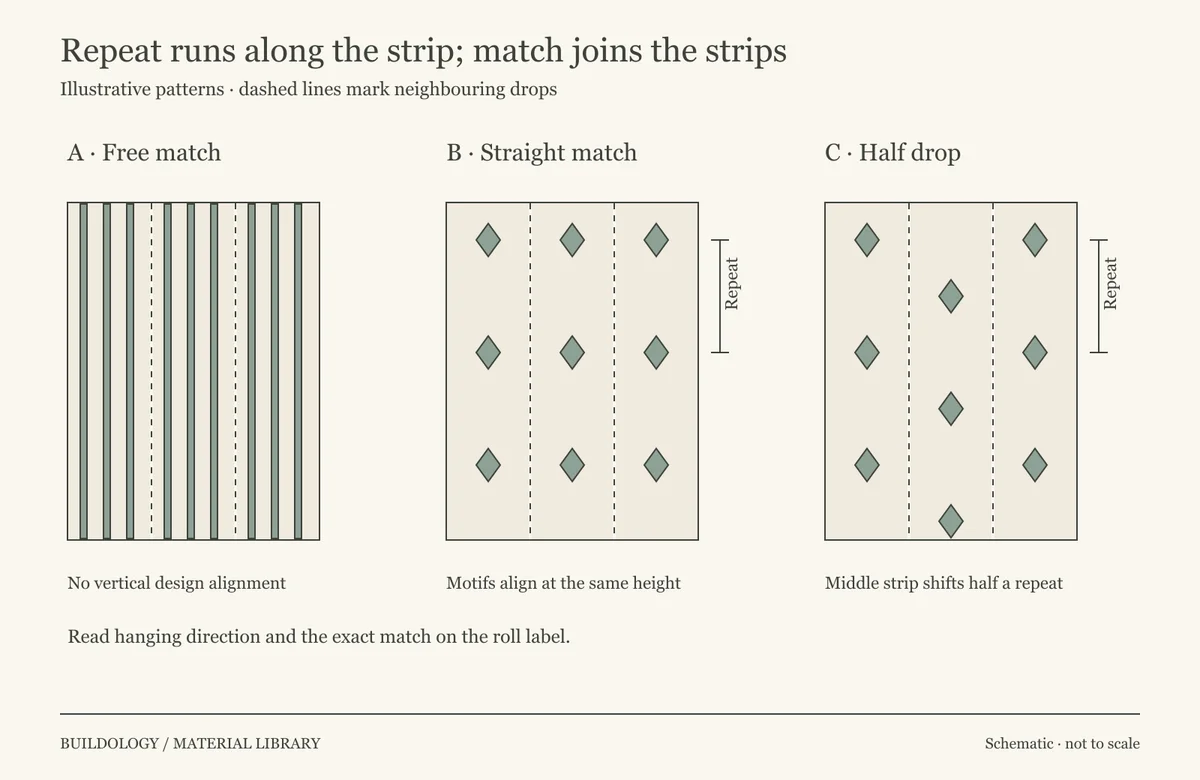
Illustration notes
Original explanatory diagram. View larger image.
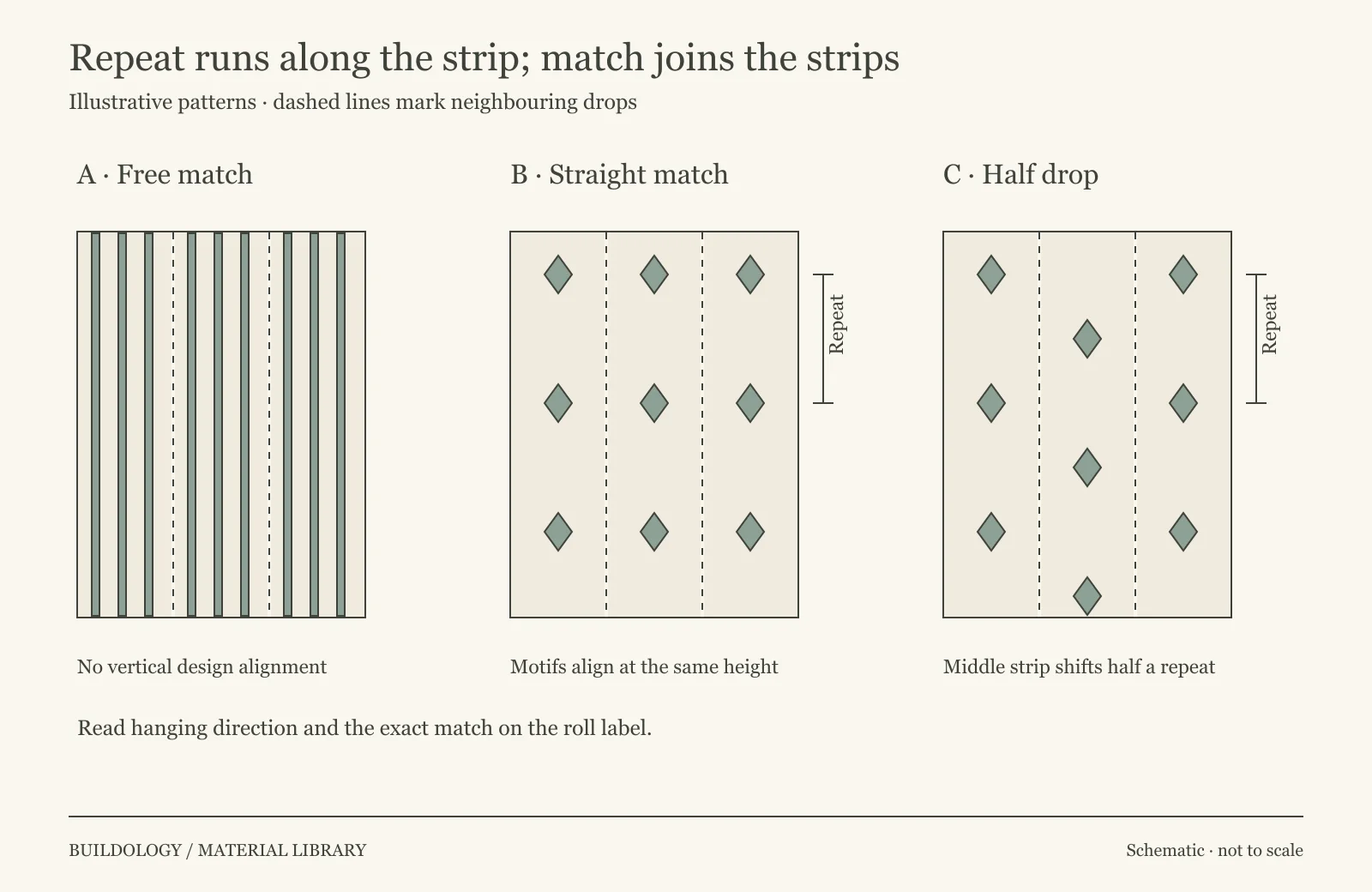
With free match, adjacent strips need no vertical adjustment to match the design, although hanging direction may still matter. Straight match aligns the same pattern level across neighbouring drops. Offset match shifts the neighbouring drop; a half-drop shifts by half the vertical repeat. Read the label rather than assume every offset is a half-drop. D09
For example, 64/32 cm describes a 64 cm vertical repeat and a 32 cm offset in Graham & Brown's example. It is not the roll width. Matching affects cutting length and waste, so wall area divided by roll area alone is not a dependable roll order. D09
When a finish changes, follow the affected layer
| Finding | Useful distinction | What changes the repair decision |
|---|---|---|
| Local shiny patch on matt paint | Surface polishing/cleaning, a different coating or lighting can look similar. | Compare lighting and use history, then trial the proposed repair. |
| Raised paper seam | Paper/adhesive/background interface, rather than automatically a structural crack. | Establish the covering, adhesion and whether the background has moved or become wet. |
| Recurrent brown mark | The stain and its moisture source are separate questions. | Resolve continuing wetting before selecting a compatible stain-blocking and finish system. |
| Loose finish with plaster attached | Failure reaches below the decoration. | Return to the plaster guide; new wallpaper or paint cannot secure loose backing. |
These are routes for reasoning, not diagnoses from a single appearance. Work from the affected layer and the evidence of what has changed.
A replacement roll has the right pattern. Is it a match?
Hypothetical example DEC-01. A wall needs two replacement drops. A spare label gives a design, colourway and 64/32 cm match. A new roll has the same design name but a different batch, and the remaining wall has faded beside a window.
Work through the match
Confirm the exact colourway, construction, roll size and pattern match before calculating the drops. The label describes the original product; it does not prove that the new batch will blend with an aged surface. Compare an actual sample in the room and agree the repair extent and stopping points before ordering. Matching the drawing alone does not match the completed wall. D08–D09
When decoration affects more than appearance
Before sanding or stripping older coatings, establish whether lead paint or asbestos-containing textured finishes may be disturbed. The plaster and finish guide links the relevant HSE guidance and conservation considerations.
For proposed work in England, Approved Document B is relevant where the surface lining's reaction to fire matters, particularly in the applicable circulation/escape context. That is different from the fire resistance of the complete wall. Check the building use, actual work and applicable edition; a finish label alone is not a fire assessment. D11
Where a proposal becomes internal insulation or work to a thermal element, use Approved Document L and the connected moisture/design guidance. Calling a product “thermal wallpaper” does not establish a compliant insulation upgrade. Published future editions have their own commencement and transition provisions. Wales, Scotland and Northern Ireland have separate regulatory routes. D12